Fable 5.2, Opus 5.5, and GPT-6.2 for coding agents
 Izzy Hurley14 min
Often, a developer is still looking at a task or ticket with some token budget in the back of their mind and wondering, “Do I need the expensive model here?”
Most vendors and most evals answer that question with the same kind of chart: benchmark score against cost. The Pareto frontier on that chart is the set of models that no other model beats on both. But in practice, these Pareto charts assume the vendor’s tasks, harness, and budgets look like yours, and they leave out the real-world costs of an unfinished patch, a missed safety case, or another round of slop review.
Anthropic’s model-choice playbook recommends starting most coding work with Opus 5.5 at medium effort and reserving Fable 5.2 for major refactors and migrations, architecture plans, and deep research. This is helpful direction but can be hard to operationalize.
If I could save hours or days on a problem, that could substantiate the Fable 5.2 price, but these types of Pareto charts are insufficient to really know that.
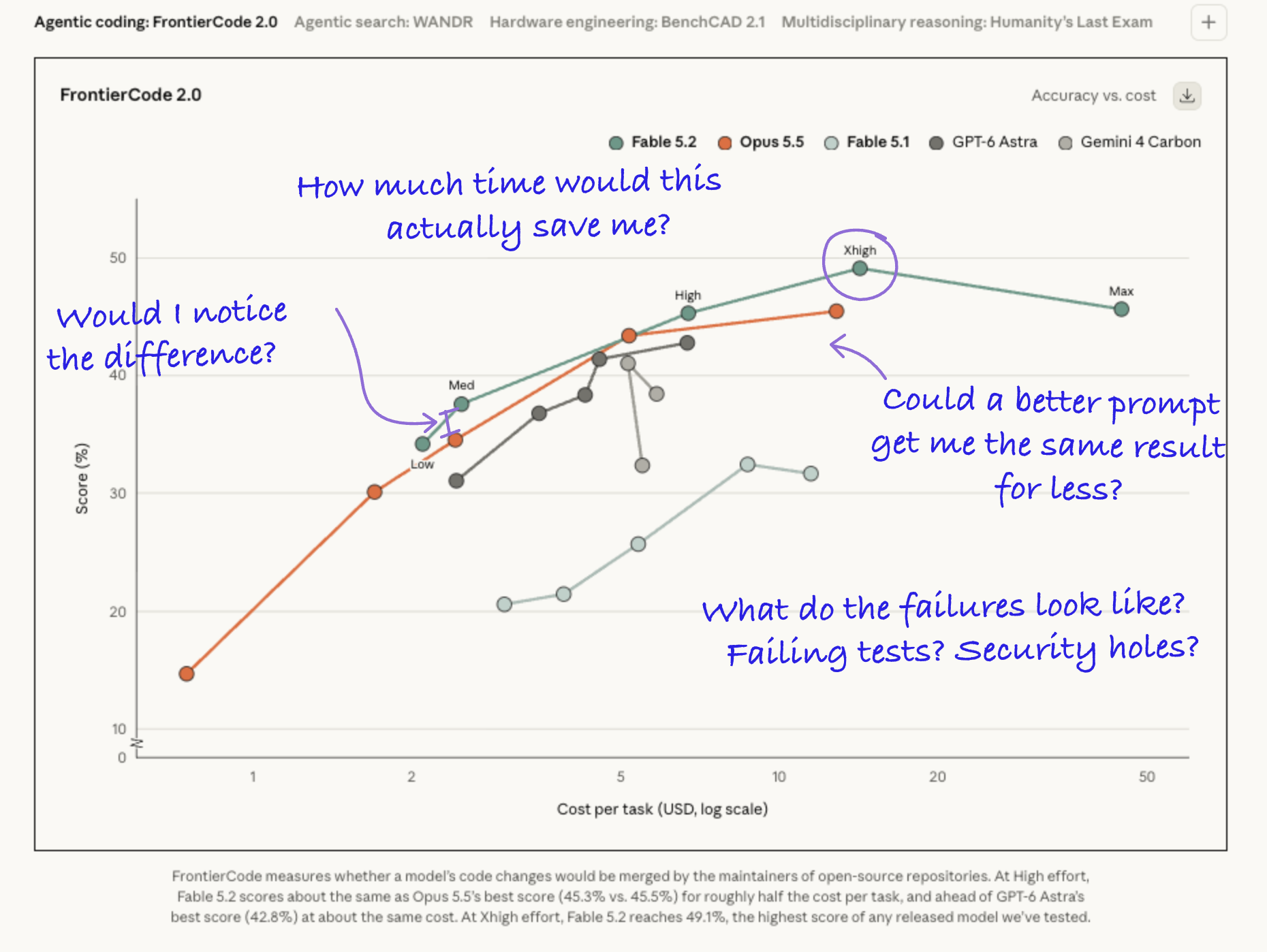
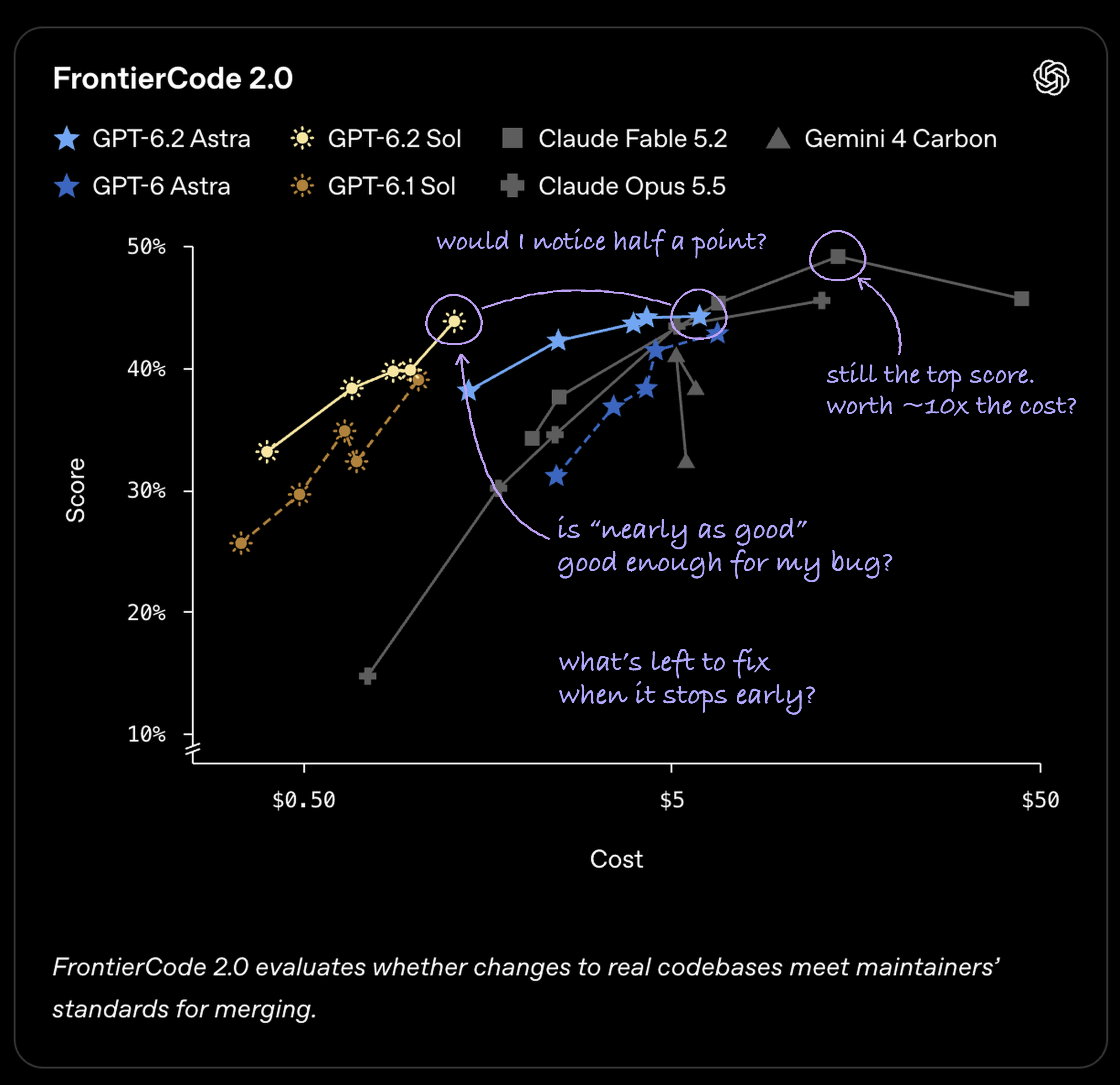
If an agent can get me 90% of the way on a bug that has been plaguing me for weeks and let me know the remaining work to be done, that might be an acceptable failure. That is very different from an agent that spins and spends re-editing the same doc over and over again or imports vulnerable dependencies.
Which requirements did the agent skip? How much work was left after its attempt?
We looked at what Fable 5.2, Opus 5.5, GPT-6.2 Sol, and GPT-6.2 Astra did on three real Braintrust PRs and how they compared to their counterparts released back in September. Every generation of Sol passed all three tasks for one to two dollars. Fable 5.2’s code also passed all three, but at roughly 25 to 40 times the cost.
Methodology
Braintrust engineers trace their coding agent sessions, and the Coding agent insights dashboard breaks that usage and cost down by user, model, tool, and branch. Those traces are where our tasks came from, and they are how we can say later where the time and money went.
I looked through our engineering team’s coding agent traces for sessions that ended in merged pull requests. I used the original requests to write the task briefs and the merged PRs to define what the code needed to do. Using these three PR-derived tasks let us inspect concrete successes, misses, and costs. I kept the sample small so I could go through the runs in detail.
The tasks
- The billing task improved the robustness of our crediting system even during temporary data outages.
- The release task redesigned how plugins get published and solidified branch protection.
- The Slack task managed linking in the Braintrust transcript workflow while continuing to reject files and unrelated attachments.
Each task required the agent to find the relevant logic, change connected code paths, and verify both the intended behavior and the cases that must still be rejected.
Eval implementation details
To test this fairly, Harbor gives each agent a local checkout of the pre-PR code, a task brief, and coding tools. We had a separate offline verifier check whether the resulting code handles the required scenarios with failure and security edge cases.
Each model ran each task twice: once in Pi, to hold the harness constant across models, and once in its native harness (Codex for the GPT models and Claude Code for the Claude models), to let it use the tools and workflows of its native environment and explore how optimized each model was for that harness.
Every run used high reasoning effort, a cap of 120 model requests, and the same container (2 CPUs, 3 GB of memory, no network access), with a per-run spending cap that we set by model.[1]
The limits cut some runs off before completion. Ensuring accurate comparisons while not unduly limiting larger models is a broader challenge in agent evaluation. Harness configs and resource budgets can shape how performance is made and measured as reported in research on agent configurations from Wiedmann, Girrbach, Schmid, and Akata as well as METR’s account of its evaluation process.
How the code was graded
Each model's saved code is graded offline against what the task brief asked for, independent of how the code is organized. For every task, the starting repo fails, the merged PR passes, and deliberately broken variants fail.
| Task | What the check does |
|---|---|
| Billing | Loads the model's real billing module with the external services mocked, then walks an account through various customer situations: missing customer, positive balance, outage, depletion, and recovery |
| Slack | Runs the model's transcript code on own-app previews, ordinary previews, and other apps' previews, with edge cases like hidden or mismatched URLs, unknown attachments, and file uploads |
| Release | Simulates the model's whole release flow for all four plugins: request, human merge, publish; then unmerged, fork, wrong-branch, bad-SHA, and wrong-version cases that must not publish |
We also reviewed the saved trajectories using specs in the AgentBehavior format. We looked at how agents investigated the code, carried requirements through revisions, responded to failed checks, and verified their final work.
Results
GPT Sol | GPT Astra | Claude Opus | Claude Fable | ||||||
|---|---|---|---|---|---|---|---|---|---|
| 6 | 6.1 | 6.2 | 6 | 6.2 | 5 | 5.5 | 5.1 | 5.2 | |
| Billing · Pi | × | × | |||||||
| Billing · native | |||||||||
| Release · Pi | × | × | |||||||
| Release · native | × | × | |||||||
| Slack previews · Pi | |||||||||
| Slack previews · native | × | ||||||||
- All versions of Sol and Fable 5.2 pass everything. Sol does so in all three generations we tested and both harnesses.
- The integrated billing task proved the hardest. The original PR that fixed this problem was worked through with Opus 5.5 in Claude Code over about 30 human turns. In this rerun test using Pi, GPT-6.2 Astra and Opus 5 fail while the other seven pass. In the native harness, all nine pass. This result speaks to the work on native harness optimizations as both models that failed on Pi passed in their own harness. With just one run per cell, this is speculative, but it is an interesting trend to explore.
- On the release task there were only four failures, and three of those four were Astra (GPT-6 Astra on Pi, GPT-6.2 Astra in both harnesses): the safety gates hold so nothing is published from an unmerged, fork, wrong-branch, bad-SHA or wrong-version PR, but one or two of the four plugins cannot be released due to manifest paths the model guessed that do not exist in the real repo (the two Pi failures), and a version stamp that is only partly committed, so the Grok plugin fails its own validation at publish (GPT-6.2 Astra in Codex). The fourth is Opus 5 in Claude Code, where one plugin can never be requested.
- Despite the fact that it originally took about an hour and a half and eight human turns (GPT-6.1 Sol in Codex) and resulted in a roughly 175-line diff, the Slack task does not separate the models. 17 of 18 cells pass; the one failure occurs with Opus 5.5 in Claude Code.
- The behavior scorer reviewed the 51 sessions that ran to completion; the other three were cut off before finishing. In every one of the 51, the agent traced the affected code before editing. The remaining checks only apply once an agent declares its work ready, which 45 of the 51 did. The other six, all in Pi, finished without making that claim. Of those 45, 40 rechecked their final code, 36 exercised the changed entry point together with its caller, and only 8 read back their own final patch.
- While the dominant narrative over the past few weeks has been the increased power of the new Fable 5.2, with some echoes of disappointment about the new GPT models, newer models did not consistently produce more passing patches in this case study. We compared one run per model, task, and harness. Given model stochasticity, a second run might change which patches pass.
Cost and time
Opus 5.5 reduced both cost and latency compared to its predecessor. It used half the money and time of Opus 5 in the Pi harness and about a quarter in the native Claude Code harness. However, Anthropic’s flagship Fable showed the opposite trend. Fable 5.2’s bill grew mostly because it ran longer. In Pi, it ran nearly four times as long as 5.1 and cost $36 versus $14, even as its per-minute rate fell from $0.40 to $0.28. In Claude Code, it ran about two and a half times as long and cost $59 versus $22, with a small increase from $0.29 to $0.31 per minute. Sol came in at about $0.10 a minute, Opus at $0.17–$0.21, and Astra at $0.31–$0.48.
Sol is flat across the newer and older models and a much cheaper option than all the Anthropic conditions at roughly $1–2 and 11–20 minutes for all three tasks. Astra barely moved between the two generations: on Pi, 6.2 was cheaper than 6 ($4.86 against $7.07) and faster (16 against 19 minutes) but in Codex the cost was flat ($6.96 against $6.88) and 6.2 took longer (23 against 14 minutes).
What the models did with the time and tokens
It may be obvious due to the focus on model reasoning and effort settings, but model reasoning or “thinking” is the primary cost driver, accounting for 47% of all spend. Visible output (text and tool calls) is only 14%.
Cache writes are second in cost at 30%. Caching was fairly effective with 92% of input tokens being read back from the cache. Interestingly of the models Fable reused its cache least, at 86%.
About 42% of all spend was used before the first edit was made to any code. This type of work is only useful if it leaves something a person or another agent can pick up. The sessions that timed out or failed before their first edit mostly left no artifacts, so we view that spend as largely wasted.
Fable took up nearly two-thirds of the bill on its own. Opus accounted for 19%, Astra 13%, and Sol 4%. You could see the difference in the traces. Across the same three tasks, Claude generated roughly 140,000–950,000 output tokens per model and harness, with 52–89% spent on thinking. GPT generated 45,000–71,000, with about 30–65% spent on thinking. Fable 5.2 had one call that ran for just over eight minutes, while the longest calls from Opus 5 and Fable 5.1 were about five minutes. Every GPT call finished in under two minutes.
Show every session on its own scale
The short GPT calls gave me more chances to see what the agent was doing. On the Slack task in Pi, GPT-6.2 Sol edited the transcript code, ran its checks, made another change, and ran them again. The whole run took just over three minutes and cost $0.31. If I were supervising it, I could step in after the first check and ask which preview cases it covered.
The first edit came about a third of the way through a typical GPT session and about halfway through an Opus session. Fable 5.2 also made me wait longer between updates. Its longest call lasted just over eight minutes, and in Claude Code, 19 calls cost at least $1 each and accounted for about two-thirds of its completed-call spend.
What each session was doing
How much work each model did and what it got for it: bar length is the number of tool calls across the three tasks, and the dots are the three task outcomes.
- More work did not buy more passes. GPT-6 Astra in Codex passed all three tasks with 34 tool calls, the fewest on the chart. Opus 5 in Claude Code made 161 and still failed release.
- Both families check about as often. 116 of 695 GPT tool calls and 116 of 691 Claude tool calls ran a test or a script, 17% each. Claude models usually write their own small harness and run it in the same command as an edit.
- Opus 5’s turn-limit cutoffs show up as edits. 71 of its 161 calls in Claude Code were edits, about three times the 24 it made on Pi.
Both families started by reading. In the second quarter, 65% of GPT’s tool calls were edits, while 48% of Claude’s were still reads or searches. If I’m following a run live, that means I’d usually have a GPT change to inspect sooner. The counts come from matching commands. An edit and a test in the same call count as a check, and some checks go uncounted when the command matcher misses them.
Where Fable's money went
Fable 5.2 got to its first billing edit much sooner in Pi than in Claude Code. In its native harness, it was still revising its patch when a dropped connection ended the run at minute 93.
| Pi | Claude Code | |
|---|---|---|
| Session time | 65 min | 93 min, cut off |
| First source edit | Minute 13 | Minute 54 |
| Output tokens (thinking share) | 385K (83%) | 510K (96%) |
| Cost, upper bound | $20.34 | $35.47 |
Nine calls in Claude Code read nothing from the prompt cache. Together they cost $24.61, including $13.42 in cache writes.
Conclusion
So which models should we be using? The benchmark plots from these launches did not prove much help on this task set. Despite taking our engineers between an hour and a half and several days, and producing diffs of 175 to 340 lines, none of these tasks was worth the premium for either version of Fable. Sol, the cheapest model line we tested, passed everything.
- Suppose two models pass the same checks on three pull requests. One costs about $2, and the other costs $59. What would you need to see in the patches to justify paying $59 again? For work like the PRs we tested, I’d start with Sol. If it repeatedly misses a requirement I care about, I have a specific way to test whether a more expensive model is worth it.
- How can you tell whether an agent is making progress before there’s a patch to inspect? I’d ask what it has ruled out and what it would change first. If it can tell me which explanation it tested and why that result matters, I can decide whether to give it more time. If it’s still running the same search, I’d narrow the task.
To see what’s happening in your team’s coding agent sessions, start tracing them with Braintrust. Then enable Patterns in your project to find recurring issues and opportunities to cut costs in your own traces.
Footnotes
- 1.The time limits were not the same across harnesses due to calibration difficulties. Pi runs had 90 minutes for the billing and release tasks and 15 minutes for the Slack task, while native runs had two hours for every task, and Pi and Claude Code were held to 60 turns while Codex had no turn limit.
Subscribe to the Department of Evals
A newsletter for unfiltered thoughts on eval methodology, analysis, and failures
Subscribe