Braintrust: Best overall for agent-driven MCP evaluations, with custom scorers, repeated trials, experiment comparisons, CI gates, and production tracing.
MCPJam: Best for protocol and client coverage through OAuth conformance checks, cross-client evaluations, and tool-selection metrics.
mcp-eval: Best for Python test suites with OpenTelemetry-backed assertions for tool calls, execution paths, and performance.
DeepEval: Best for scoring recorded MCP interactions across primitive use, generated arguments, and task completion.
MCP Inspector: Best for inspecting tools, resources, prompts, transports, and authentication through web, CLI, and TUI clients.
What MCP testing is and how it differs from agent evaluation
MCP testing determines whether a server works correctly when clients and agents connect. Protocol checks validate whether the server follows the MCP specification, including session initialization over stdio or Streamable HTTP, legacy SSE support where required, and correct responses to tools/list, resources/read, prompts/get, and authentication requests. Behavioral checks add a model to determine whether tool descriptions and schemas produce the intended calls.
Valid JSON-RPC traffic does not guarantee useful agent behavior. Ambiguous tool names, overlapping descriptions, permissive schemas, or unhelpful responses can steer a model toward the wrong action without triggering a protocol error. Teams that own both the MCP server and the agent should combine server checks with agent testing, covering isolated decisions, complete trajectories, regression suites, and production behavior.
| Dimension | MCP testing | Agent evaluation |
|---|---|---|
| System under test | MCP server and its contract with clients | Agent application, including its model, prompts, orchestration, and tools |
| Who initiates calls | MCP client, inspector, or external agent | The team's agent runtime and model configuration |
| Available evidence | Transport messages, exposed primitives, arguments, and server responses | Prompts, context, memory, tool calls, state changes, and final output |
| Typical failure | Connection or authentication fails, a primitive is unavailable, or the model misuses the server because its description or schema is unclear | The agent plans incorrectly, loops, mishandles a result, or stops before completing the task |
| Primary scoring surface | Protocol success, tool selection, argument validity, and result usability across clients | Step correctness, trajectory quality, task completion, and final system state |
| Release decision | Whether the server works across its intended clients | Whether an agent configuration is ready for production |
How we selected the best MCP testing tools
Seven criteria determined the ranking, and each reflects a capability teams can verify in a short technical review.
Server connection and transport coverage: We assessed direct connections to running servers over stdio, SSE, and Streamable HTTP, plus OAuth handling for protected remote servers.
Language and runtime support: We gave more credit to tools that match common testing languages and remain compatible with MCP servers implemented in other languages.
Model support: Tools received more priority when they let a real model choose how to use the server and supported multiple model providers for broader behavioral coverage.
Scoring depth: We examined whether scoring covered primitive selection, generated arguments, task completion, and the resulting system state.
Custom scorers and repeated trials: Higher-ranked tools combine deterministic checks with LLM judges and support configurable trial counts for measuring variance.
CI reporting and release gates: Machine-readable reports, baseline comparisons, and configurable thresholds make evaluation results enforceable during pull requests and releases.
Production use and data handling: Live scoring, retained traces, and options for data residency or self-hosting contributed to the final ranking.
Also read: Best AI evaluation tools for AI systems in production
The 5 best MCP testing tools in 2026
1. Braintrust
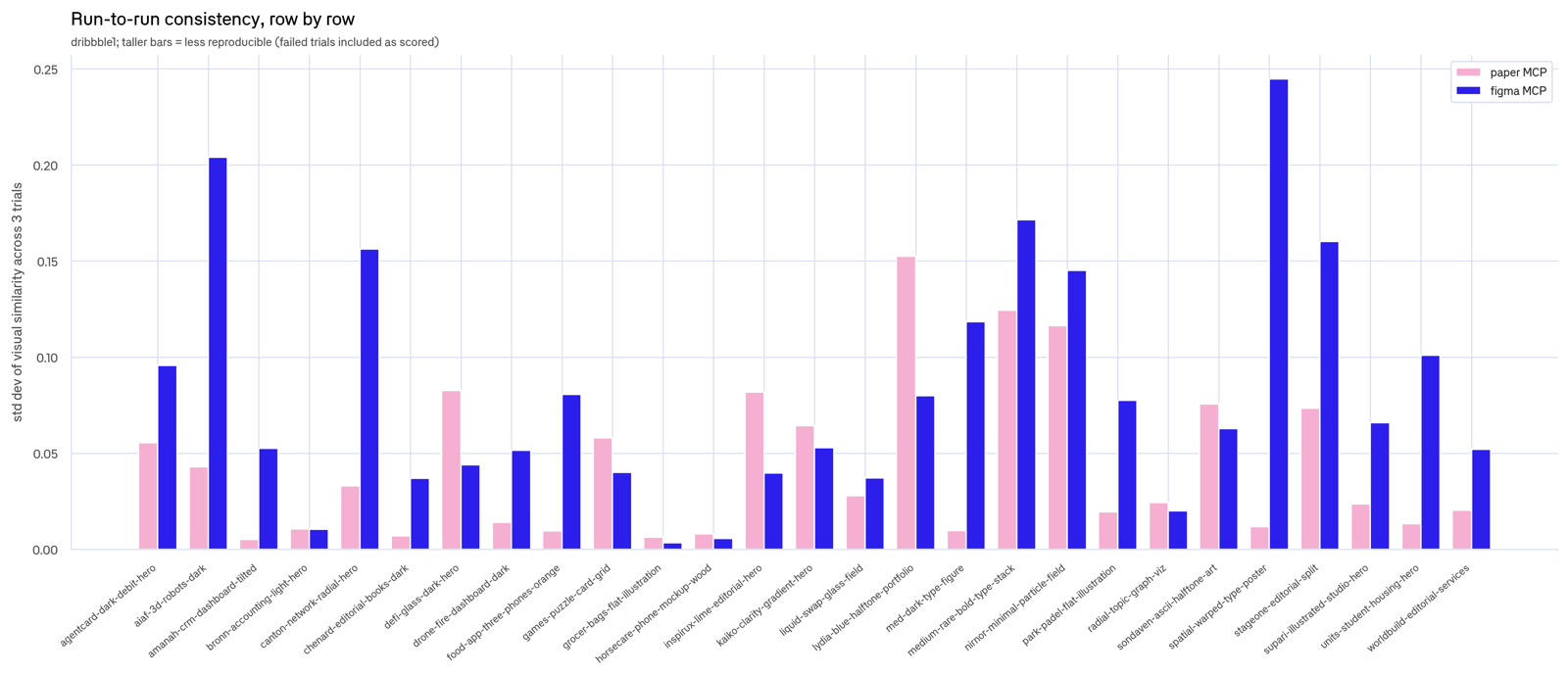
Braintrust is the strongest overall choice for teams that use MCP evaluation results to decide what can ship. The eval task runs the team's agent or MCP client against the target server, and each dataset run becomes a comparable experiment. The experiment preserves the configuration and results needed to evaluate server versions under consistent conditions.
The Paper and Figma MCP server evaluation demonstrates a complete Braintrust MCP eval under controlled conditions. Each dataset row launched a headless Claude Code session with exactly one MCP server attached, and 27 complex design tasks ran three times per server. Paper scored 0.716 on visual similarity against Figma's 0.679, though the 0.037 margin was not statistically significant at p = 0.21. Repeated runs separated the two servers on reproducibility and cost, with Figma showing 1.9 times greater run-to-run variance and $3.73 per point of visual quality against Paper's $2.82.
Scoring tool calls and task outcomes
Deterministic checks and LLM judges run inside the same Braintrust evaluation. Each scorer returns a value between 0 and 1, and a configured threshold determines whether the run passes. In Braintrust's Paper and Figma MCP evaluation, render_success and visual_similarity ran as code-based checks, and recreation_faithfulness used an LLM-as-a-judge model at temperature 0 with a fixed prompt.
For an MCP server owned by your team, a custom scorer can verify that the agent called create_invoice before send_invoice, copied the correct amount from an earlier lookup, and created the invoice in the test billing system. Braintrust's agent evaluation guidance recommends stubbing external dependencies with enough production or staging state to keep tool-order, argument, and final-state checks reproducible without moving real money.
Repeated trials and server comparisons
One passing run cannot establish that a model will interpret a tool description consistently. Multiple trials per input run through trial_count, and Braintrust reports the distribution across repeated runs. Individual dataset rows can override the global count when a high-impact tool or unstable task needs additional coverage.
Experiment comparison places server versions, models, or prompt configurations side by side and shows score changes for each task. Teams use the comparison to measure the effect of a rewritten tool description, confirm that a lower-cost model still selects tools correctly, or locate a regression introduced by a new server version.
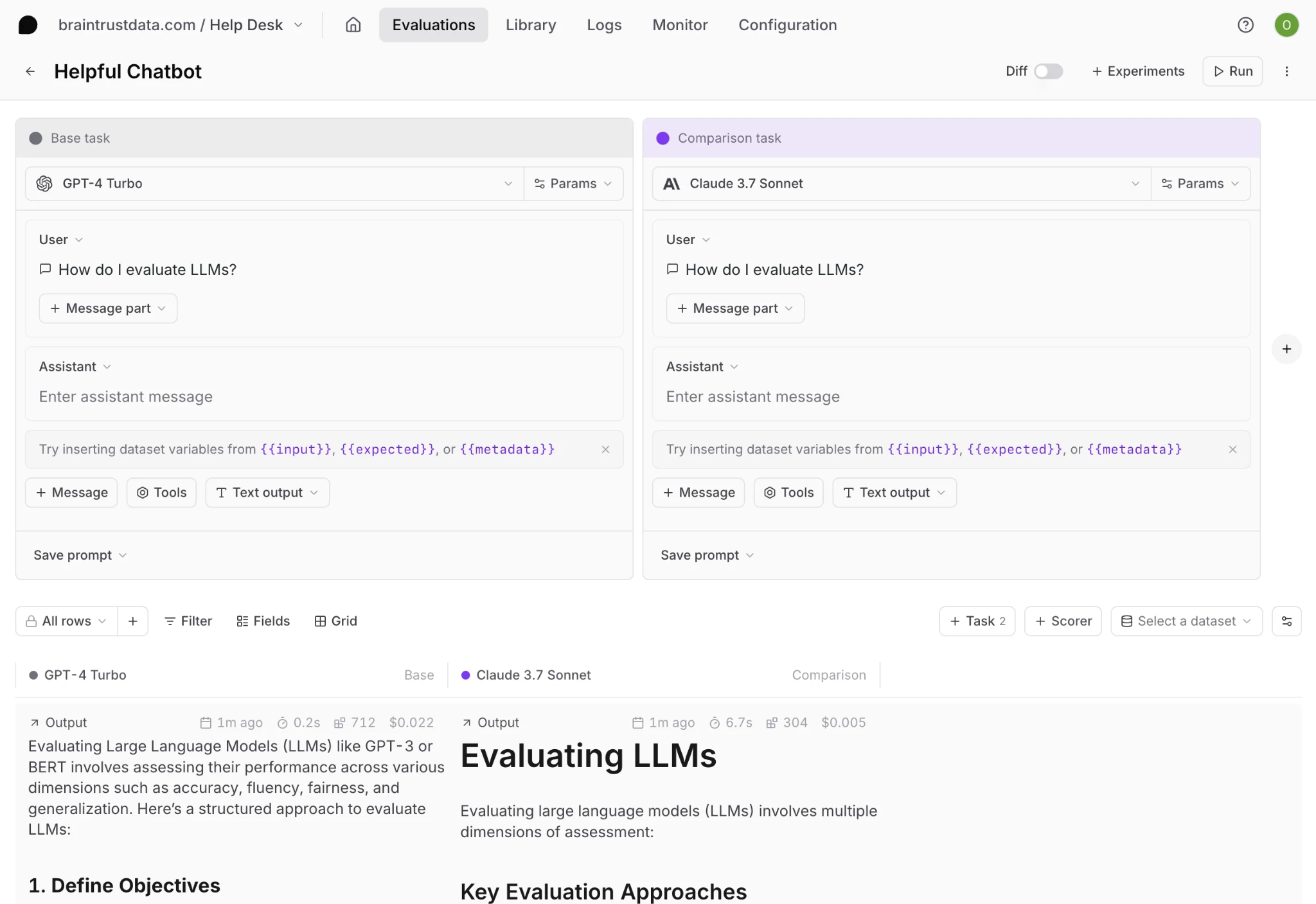
In playgrounds, teams can run an MCP dataset across prompts, models, and scorers before saving a configuration as an experiment. Native MCP connections support public OAuth-enabled servers in playgrounds and UI-created experiments, and SDK evaluations connect through the team's agent code. Loop can analyze a failed MCP trace and generate related dataset rows, filters, or scorers from a plain-language description of the failure.
Tool-call traces for each MCP request
Every instrumented agent run opens as a nested span tree, so an engineer can move from a failed task to the exact MCP request that caused it. In Braintrust's Paper and Figma MCP evaluation, one experiment row recorded 14 MCP tool calls across 42 turns and included a permalink to the agent's full internal trace. The linked Claude Code trace showed the call sequence, the arguments sent to each server, and the responses passed back to the model.
Braintrust can trace application logic outside the model call, such as retrieval steps, preprocessing, and tool invocations. Inputs, outputs, errors, and timing remain attached to the corresponding spans, which helps distinguish a poor tool description from an invalid schema, server error, or prompt failure.
CI gates and production regression datasets
Braintrust's GitHub Action and bt eval CLI can run MCP evaluations on pull requests and report results against a baseline experiment. A custom Reporter() rule can return a failing exit status when a required score falls below its release threshold. Run a representative subset on pull requests and reserve the complete dataset for merges or release candidates to control model spend.
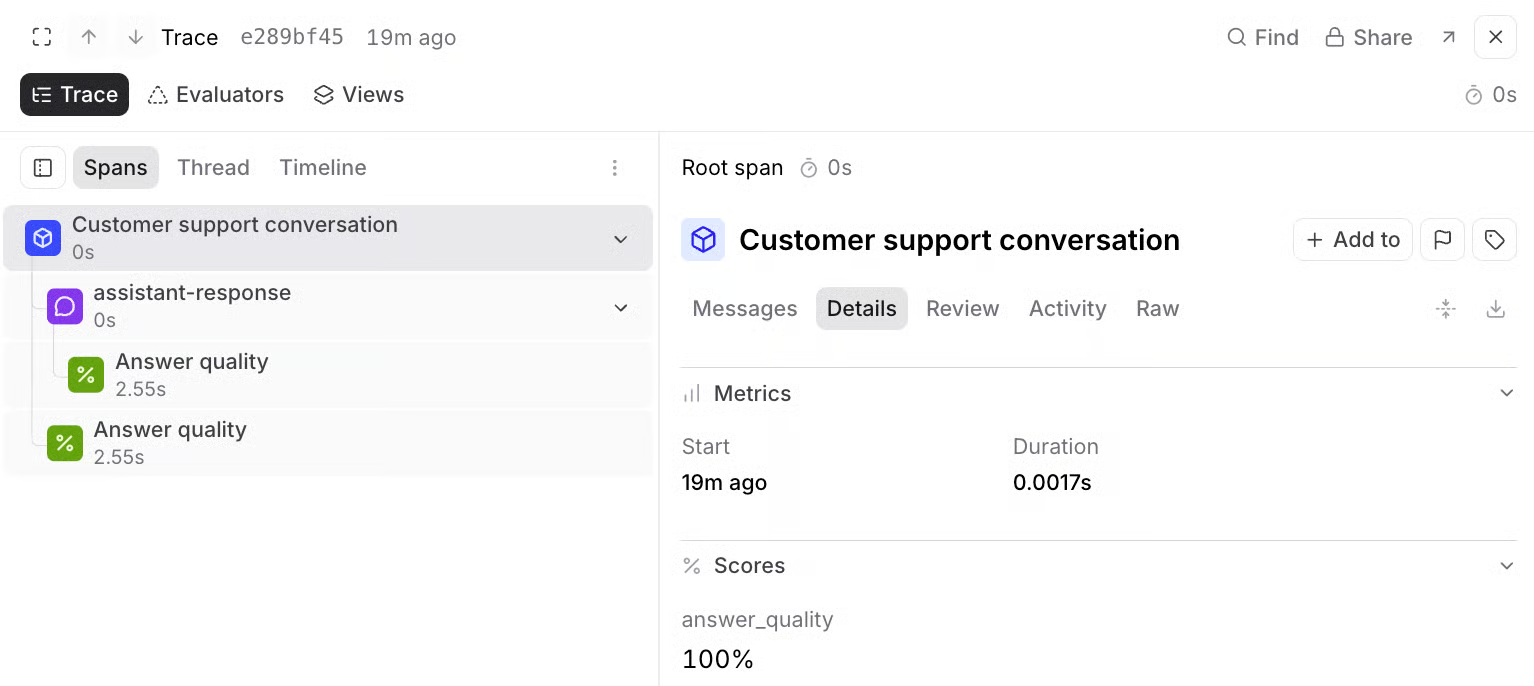
After release, online scoring evaluates selected production traces asynchronously without adding latency to user requests. Low-scoring MCP interactions can be reviewed and promoted into a versioned dataset, so later CI runs cover failures observed in live traffic.
Braintrust also provides an MCP server for developer tools, so Claude Code, Cursor, and other supported clients can query Braintrust experiments and production logs during an investigation without leaving the editor.
Best for: Teams shipping MCP servers or MCP-enabled agents that need tool-level scoring, repeated trials, trace-based debugging, release gates, and production regression coverage in one evaluation record.
Pros
- Real agent execution exposes failures caused by tool descriptions and schemas that protocol checks cannot detect.
- Span-level and trace-level scoring separates incorrect tool calls from unsuccessful task outcomes.
- Configurable trial counts distinguish consistent server behavior from a one-off pass.
- Row-level experiment comparisons reveal which tasks changed after a server, model, or prompt update.
- Nested spans keep inputs, outputs, errors, timing, latency, and cost attached to each MCP call.
- External dependency stubs keep stateful write and delete tests safe and reproducible.
- Playgrounds cover browser-based MCP evaluation, and SDK evals support automated agent harnesses.
- GitHub Actions, bt eval, and custom reporters turn score requirements into enforceable CI rules.
- Production scoring converts confirmed live failures into regression cases for later releases.
- Loop reduces the manual work required to expand datasets and scorers from failed traces.
Cons
- Self-hosting requires an Enterprise plan.
- Protocol conformance and OAuth debugging require an MCP inspector.
Pricing: Free Starter plan with 1 GB processed data, 10K scores, and unlimited users. Pro at $249/month. Custom enterprise pricing. See pricing details.
2. MCPJam
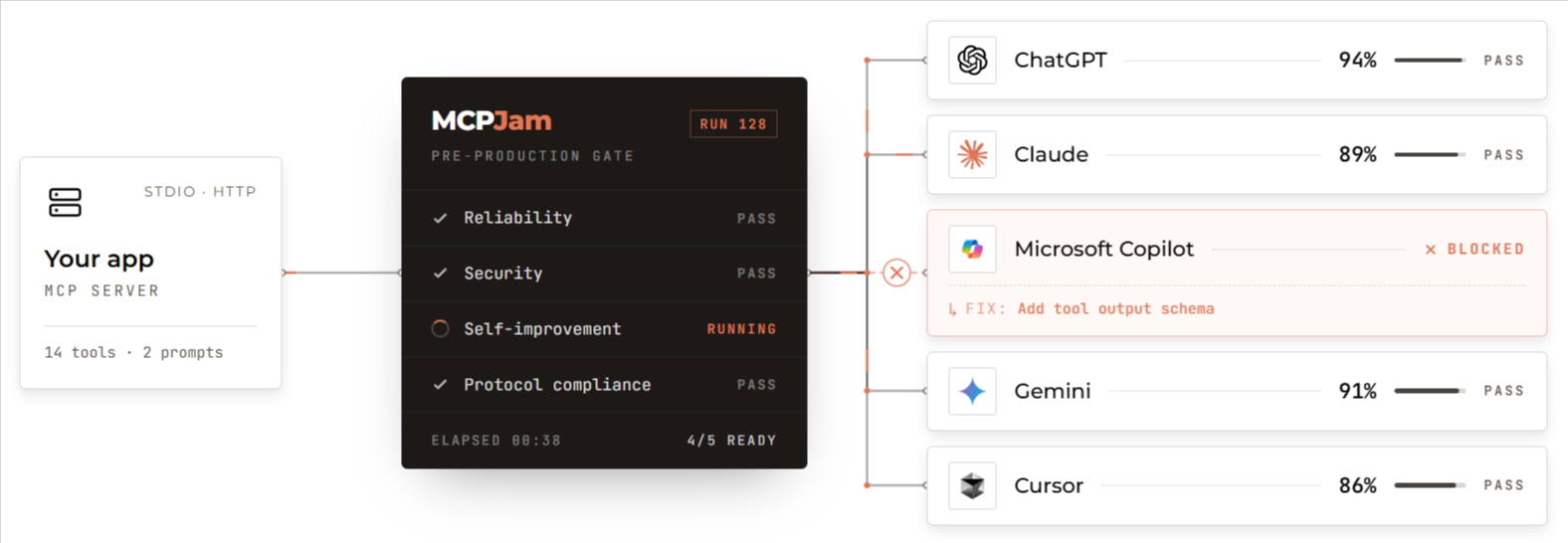
MCPJam began as a fork of the official MCP Inspector and now combines protocol inspection, OAuth conformance, and agent-driven testing for MCP servers, MCP apps, and ChatGPT apps. MCPJam runs through a local inspector, hosted app, CLI, and TypeScript SDK for Jest or Vitest. Its cross-client evaluations measure tool selection and argument construction across Claude, ChatGPT, Cursor, Copilot, Codex, and other supported clients, but do not extend to task-level production scoring.
Best for: Server developers who need protocol conformance, OAuth debugging, and cross-client behavior checks before a release ships.
Pros
- Connects over stdio, SSE, and Streamable HTTP and supports manual inspection of tools, resources, prompts, and elicitation flows.
- Reports accuracy, true positive rate, false positive rate, precision, token usage, and client-specific results.
- Runs local and CI tests through @mcpjam/cli and @mcpjam/sdk, with JUnit and JSON reporting.
Cons
- Custom grading of final answers and resulting system state requires a separate evaluator.
- MCPJam does not score interactions from live production traffic.
Pricing: Free plan with standard features. The paid plan starts at $30 per month when paid annually. Custom enterprise pricing with annual commitments.
3. mcp-eval
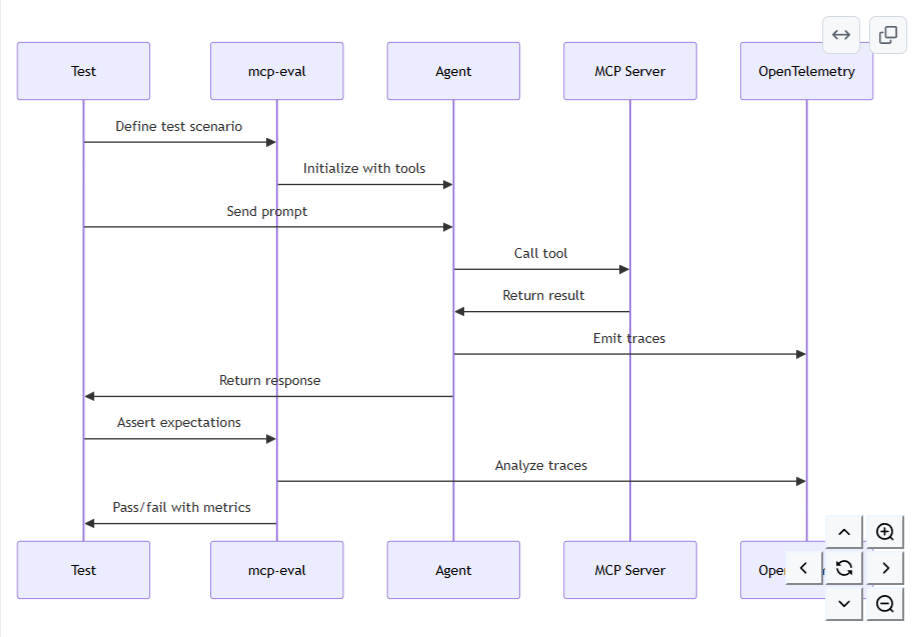
For Python test suites, mcp-eval sends a real agent to a running MCP server and derives assertions from the resulting OpenTelemetry traces. Tests support @task decorators, pytest fixtures, and dataset-driven cases against servers written in any language. The Expect API checks tool usage, call order, prohibited actions, latency, and judged output quality, but experiment history remains outside the package.
Best for: Python developers who want MCP-specific assertions for tool usage, execution path, content, and performance written directly in pytest.
Pros
- Validates tool calls, execution order, prohibited actions, output content, latency, and path efficiency.
- Derives assertion results, token usage, latency, and cost from the same OpenTelemetry trace.
- Generates test cases from server tools and publishes JSON, HTML, or Markdown reports through GitHub Actions.
Cons
- Test authoring requires Python, even when the MCP server uses another language.
- Local reports provide no shared experiment history without an external result store.
Pricing: Free (open-source)
4. DeepEval
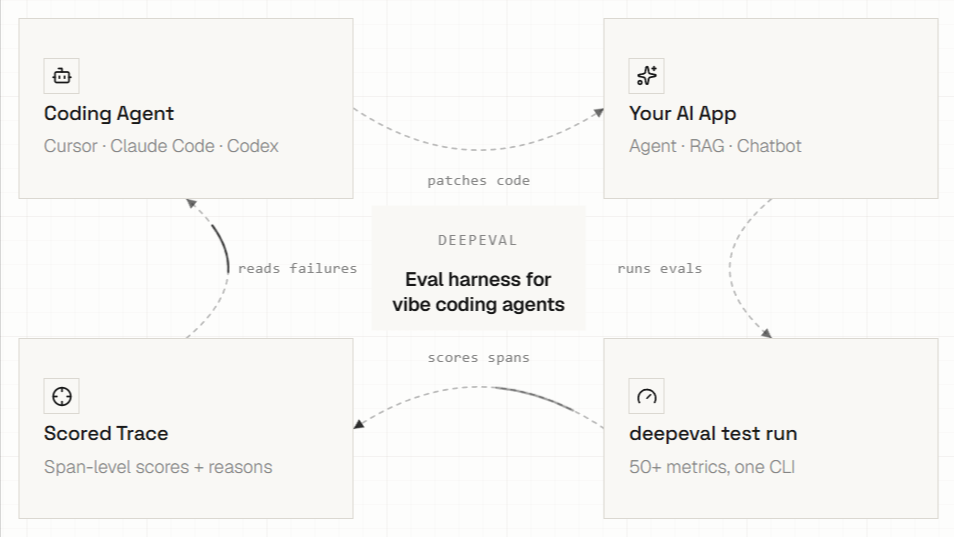
Recorded MCP interactions provide the input for DeepEval's MCP evaluation metrics. MCPUseMetric scores primitive selection and arguments for one turn, MultiTurnMCPUseMetric covers conversations, and MCPTaskCompletionMetric grades whether the interaction fulfilled the user's request. Test cases supply mcp_servers and recorded primitive calls, so the application must complete and capture the MCP session before DeepEval begins scoring.
Best for: Python developers already using DeepEval who want MCP scoring inside an existing metric suite.
Pros
- Separates single-turn MCP use, multi-turn MCP use, and task completion into dedicated metrics.
- Provides 50+ predefined metrics and supports custom criteria through GEval.
- Runs through pytest and connects local evaluation results to Confident AI reports.
Cons
- DeepEval does not connect to MCP servers or negotiate their transports.
- MCP metrics use LLM judges, so every selected metric adds model usage.
Pricing: Free (open-source). Paid plans through Confident AI.
5. MCP Inspector
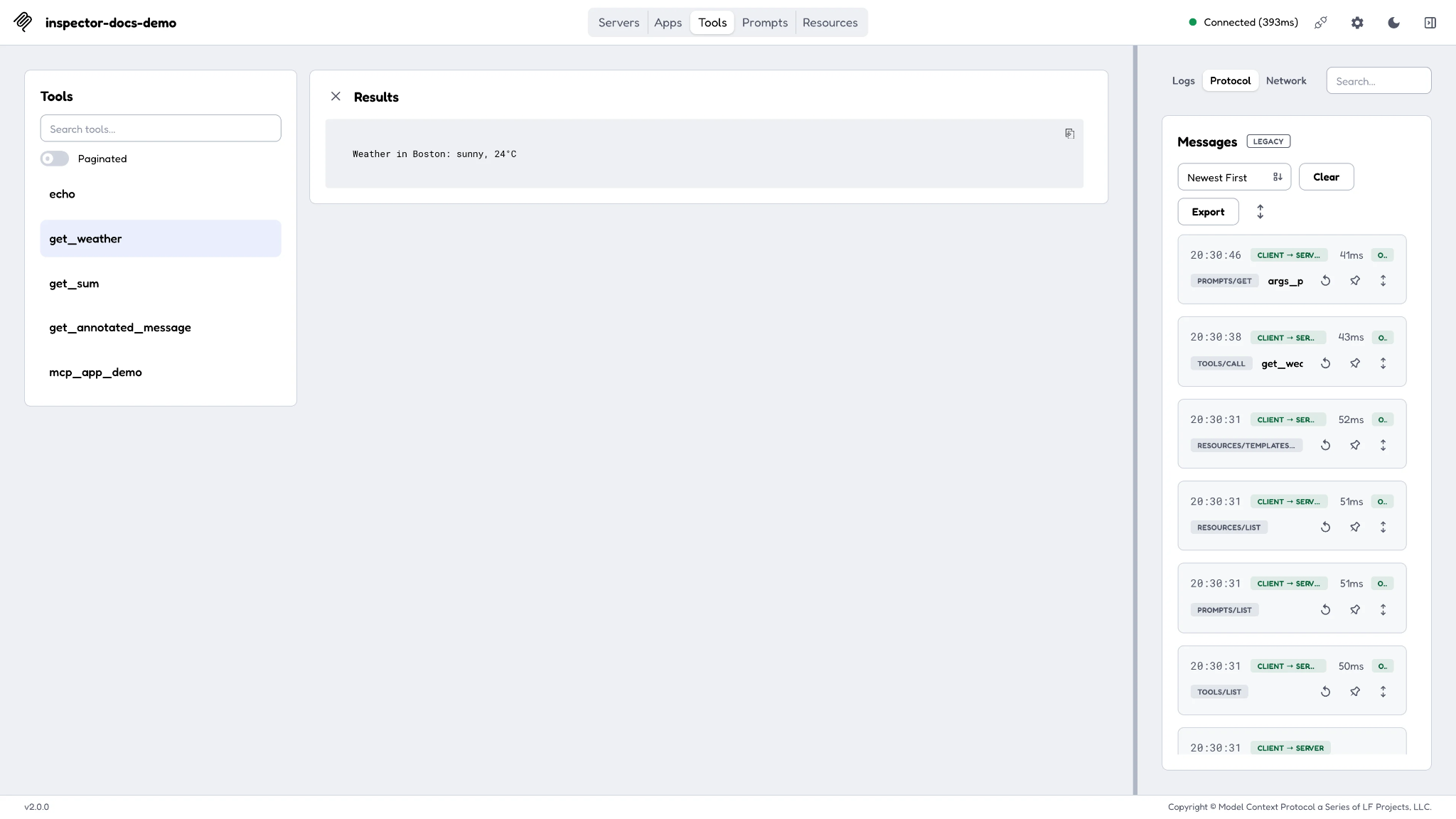
Maintained by the Model Context Protocol project, MCP Inspector packages a React web interface, scriptable CLI, and terminal UI behind one mcp-inspector binary. Connections run over stdio, SSE, and Streamable HTTP, exposing tools, resources, prompts, elicitation, sampling, subscriptions, tasks, pagination, OAuth, and protocol messages for inspection. MCP Inspector verifies server behavior at the protocol level without running a model or scoring tool-selection decisions.
Best for: Server developers debugging protocol conformance, transports, authentication, and MCP primitives during local development.
Pros
- Provides web, CLI, and TUI clients in one installation with a shared connection runtime.
- Displays MCP requests, responses, OAuth state, standardized Mcp-* headers, and JSON-RPC errors.
- Supports scripted CLI checks and a published container image for reproducible CI runs.
Cons
- MCP Inspector cannot measure whether a model selects the correct tool or completes the requested task.
- MCP Inspector does not retain experiment history, repeat trials, or compare behavioral regressions.
Pricing: Free (open-source)
Best MCP testing tools compared (2026)
| Dimension | Braintrust | MCPJam | mcp-eval | DeepEval | MCP Inspector |
|---|---|---|---|---|---|
| Starting price | Free Starter plan includes 1 GB of processed data, 10K scores, 14-day retention, and unlimited users, projects, datasets, playgrounds, and experiments. | Free tier available. | Free (open-source) | Free (open-source) | Free (open-source) |
| Best for | Real-agent MCP evaluation across tool calls, task outcomes, repeated trials, experiment history, CI gates, and production regression coverage. | Protocol conformance, OAuth testing, MCP Apps, and cross-client behavior before release. | Python test suites that need MCP-specific assertions derived from execution traces. | Python projects that need reusable metrics for recorded MCP interactions. | Local protocol, transport, authentication, and primitive debugging. |
| Notable features | Code and LLM scorers, trial_count with case-level overrides, playgrounds, immutable experiments, per-case comparison, nested spans, Loop, CI integration, and online scoring. | Inspector, OAuth conformance, cross-client evaluations, TypeScript SDK, agent traces, and JUnit or JSON reports. | Expect assertions, OpenTelemetry metrics, generated test cases, custom evaluators, and JSON, HTML, or Markdown reports. | MCPUseMetric, MultiTurnMCPUseMetric, MCPTaskCompletionMetric, GEval, pytest integration, and Confident AI reports. | Web, CLI, and TUI clients, OAuth, legacy and modern protocol support, MCP Apps inspection, and a container image. |
| Connects to real MCP servers | ✅ SDK evaluations connect through the evaluated agent code, and playgrounds support public OAuth-enabled MCP servers. | ✅ Supports stdio, SSE, and Streamable HTTP with OAuth testing. | ✅ A real agent connects to MCP servers written in any language. | ❌ The application must execute and record the MCP session before DeepEval begins scoring. | ✅ Connects over stdio, SSE, and Streamable HTTP for protocol-level testing. |
| Model in the loop | ✅ The actual agent and model run against dataset cases, with repeated trials available for variance measurement. | ✅ Evaluation cases run across supported models and client configurations. | ✅ Supports Anthropic, OpenAI, Google, and custom providers through the agent harness. | ⚠️ Judge models score recorded interactions, but the application model executes outside DeepEval. | ❌ MCP Inspector invokes primitives directly without an agent model. |
| Tool-call tracing | ✅ Nested spans preserve tool arguments, results, errors, timing, latency, cost, parent relationships, and trace permalinks. | ✅ Agent traces record tool decisions, and raw JSON-RPC logs expose server messages. | ✅ OpenTelemetry spans capture calls, latency, tokens, cost, errors, and conversation metrics. | ⚠️ MCP calls must be recorded in test cases. DeepEval tracing and Confident AI can add tool spans. | ⚠️ Live protocol and console views expose MCP messages, but MCP Inspector does not preserve an agent trajectory. |
| Custom scorers | ✅ Code scorers and LLM judges can evaluate complete traces or individual spans within the same experiment. | ⚠️ Supports expected calls, argument checks, deterministic assertions, and optional LLM judges. | ✅ Supports Expect assertions, LLM judges, and custom BaseEvaluator classes. | ✅ Supports GEval, custom BaseMetric classes, conversational metrics, and deterministic code metrics. | ❌ No scoring layer. |
| Model and version comparison | ✅ Immutable experiments compare models, prompts, agent configurations, and MCP server versions with per-case score deltas. | ⚠️ Cross-model and cross-client results show accuracy differences and pass-rate history. | ⚠️ Separate reports support regression analysis, but mcp-eval has no shared comparison interface. | ⚠️ Test runs support side-by-side regression analysis, and Confident AI can maintain an official comparison baseline. | ❌ No model, server-version, or behavioral comparison. |
| CI regression gates | ✅ GitHub Actions and bt eval compare results with a baseline experiment. Custom reporters can fail a build when score requirements are missed. | ✅ CLI and SDK checks return pass or fail results and export JUnit or JSON reports. | ✅ Prebuilt GitHub Actions publish reports, comment on pull requests, and fail on assertion errors. | ✅ deepeval test run returns a failing exit code when a required metric misses its threshold. | ⚠️ The CLI supports scripted protocol checks but has no behavioral score gate. |
| Production tracing | ✅ Online scoring evaluates sampled live traces asynchronously, supports span-level scores, and promotes production failures into regression datasets. | ❌ MCPJam focuses on pre-release testing. | ❌ OpenTelemetry traces belong to test executions and local reports. | ⚠️ Confident AI runs online metrics on production traces and spans. | ❌ MCP Inspector does not trace production traffic. |
Upgrade your MCP evaluation workflow with Braintrust. Start free today →
Why Braintrust leads for MCP evaluation
An MCP evaluation should inform the release decision and the production investigation that follows. Braintrust keeps the evaluation criteria and supporting trace connected across development experiments, CI checks, and production review, which gives every score a verifiable basis and every confirmed failure a path into future regression coverage. Server, model, prompt, and agent changes remain tied to the evidence used to approve the release.
Engineering organizations at Notion, Stripe, Vercel, Instacart, Zapier, and Ramp use Braintrust for production AI evaluation. Notion keeps 70 engineers aligned through a shared evaluation framework and deploys frontier models within hours of release.
Run MCP evaluations from development through production with Braintrust →
FAQs about MCP testing tools for agent evals (2026)
What is an MCP evaluation framework?
An MCP evaluation framework turns representative user requests into repeatable tests for an MCP server. Each test defines the available tools, expected behavior, and pass conditions, then captures tool calls, arguments, responses, and scores to explain the result.
How do MCP evals relate to agent evals?
MCP evals apply agent evaluation methods to the boundary between an AI client and an MCP server, isolating whether tool descriptions, schemas, and responses guide the agent correctly. Running them first saves rework, since a misleading schema corrupts every downstream trajectory score. Broader agent evaluations then assess planning, retrieval, memory, and final outcomes with the server contract already known to be sound.
How do I choose the right MCP server testing tool?
Choose a tool based on the decision its results must support. Protocol inspectors suit connection, authentication, and specification checks. Model-driven evaluation is necessary for tool selection, argument quality, and task completion. Production releases also require CI evaluation, regression thresholds, and support for the server transport, test language, model providers, and data requirements.
Is Braintrust better than MCPJam?
Braintrust is the stronger choice when MCP quality must be measured with custom scores, compared against a baseline, enforced in CI, and monitored after release. MCPJam focuses more closely on OAuth conformance, protocol compatibility, and behavior across external AI clients. Organizations may use MCPJam for conformance checks and Braintrust for release decisions and production quality.
What are the best alternatives to MCP Inspector?
MCPJam is the closest alternative for protocol inspection and OAuth debugging, and mcp-eval adds Python-based behavioral assertions over a live server. Braintrust is the best alternative when you need model-driven evaluation experiments, release thresholds, and production scoring beyond manual protocol inspection.