OpenRouter alternatives: 6 unified LLM APIs compared (2026)
OpenRouter reduces multi-model setup by exposing hundreds of models through a single OpenAI-compatible endpoint. One account and prepaid balance are enough to compare frontier and open models without separate provider onboarding.
In production, every model change requires evidence of improved output quality before it reaches users. OpenRouter records model usage, provider, cost, and timing, but it doesn't make response quality a release requirement, so evaluation remains separate.
This guide compares six OpenRouter alternatives across SDK compatibility, pricing and markup, caching, cost attribution, self-hosting, observability, and support for scoring and replay. Braintrust Gateway is the strongest choice for production because every routed request can feed the tracing, evaluation, and release checks that decide whether a change ships. Start free with Braintrust Gateway.
What OpenRouter does well
OpenRouter brings together more than 500 models from OpenAI, Anthropic, Google, Meta, Mistral, DeepSeek, and other providers into a single catalog, and switching between them requires only a different model slug in the request. Model usage follows provider list prices, and free variants are available for basic routing tests before paid traffic begins.
OpenRouter's Auto Router chooses a model based on the prompt, and provider preferences determine which upstream host serves the request. Routing rules can prioritize price, throughput, or latency, restrict eligible providers, and move a failed request to another endpoint without an application change.
Catalog breadth and configurable routing reduce the engineering effort required for early model comparisons because the client code remains unchanged as models and providers change. Once routing decisions must connect to feature-level cost attribution and measured output quality, OpenRouter needs supplementary tooling for both.
Where OpenRouter falls short in production
Evaluation: OpenRouter's Ori Eval can compare models, score open-ended answers with an LLM judge, and fail a CI job. Its repository-based eval files remain separate from production logs, so a low-quality live response does not become a reusable regression case or automatically receive online scoring. Additional instrumentation or another evaluation system is required to connect production failures to release checks.
Pricing: OpenRouter passes provider token rates through without markup, then charges a 5.5% fee when credits are purchased. BYOK is not free. It carries no fee up to a monthly allowance of $25,000 in list-price inference on pay-as-you-go, and OpenRouter charges 5% above that. This percentage-based pricing makes OpenRouter a larger recurring expense as inference volume grows.
Cost attribution: Activity reporting groups spend by model, API key, creator, or workspace. Feature- and customer-level breakdowns depend on how keys and workspaces are structured, so finer reporting requires naming conventions or downstream analytics.
Observability: OpenRouter's opt-in Input & Output Logging stores prompts, completions, model, provider, token counts, and cost for individual requests. Multi-step traces and broader production monitoring depend on external tools connected through Broadcast.
OpenRouter remains useful for model discovery and centralized access, but an alternative earns the migration effort when routed traffic must feed directly into shared evaluations, online scoring, and release controls. Braintrust's guide to avoiding LLM provider lock-in explains how to keep model choices portable when moving between gateways.
How to evaluate OpenRouter alternatives
Comparing OpenRouter with other unified LLM API providers begins with the current workload. A viable replacement should keep existing requests working and address OpenRouter's production limitations.
OpenAI SDK compatibility: Run an existing production-shaped request against the candidate endpoint and record every required code change. Updating the base URL, key, and model identifier keeps the migration contained, but a custom SDK or response schema turns the switch into a refactor.
Provider and model breadth: Build the comparison from the models and providers already used through OpenRouter, then add those likely to be tested next. Confirm that custom, self-hosted, and fine-tuned endpoints can use the same client if they are part of the product roadmap.
Pricing model and fees: Calculate the total gateway cost based on the current monthly volume, including platform fees, BYOK charges, plan fees, cache savings, and self-hosting infrastructure costs. Using the same traffic estimate makes percentage-based, fixed-price, and open-source options directly comparable.
Caching: OpenRouter already ships response caching, so a replacement has a baseline to match. Test repeated requests with the application's actual prompts, then compare the caching controls that affect production use, including TTLs, cache scope, encryption, and whether cache hits remain visible in logs.
Cost attribution: Send the project, feature, and customer metadata used in production, then check whether cost reports can group spend by each field. A replacement improves on OpenRouter's model-, API-key-, and workspace-level reporting only if finer breakdowns don't require separate keys or manual exports.
Self-hosting and deployment control: Compare the control gained from self-hosting against ownership of deployment, databases, scaling, upgrades, and incident response. For managed alternatives, verify that the available regions and deployment options meet existing data residency requirements.
Observability depth: Trace one failed multi-step request from the user input through every model and tool call. Check whether the candidate keeps application steps, provider choice, cost, latency, and errors in a single trace, or sends part of the production record to an external destination.
Scoring and replay: Use one low-quality production response as the evaluation case. Since Ori Eval already compares models and can fail CI, assess whether the candidate can score the live response, convert it into a reusable case, replay it against candidate models, and apply the result to a release decision without manual exports. For quality-aware LLM routing, verify that model selection can use the same evaluation results alongside cost and availability.
6 best OpenRouter alternatives in 2026
1. Braintrust Gateway
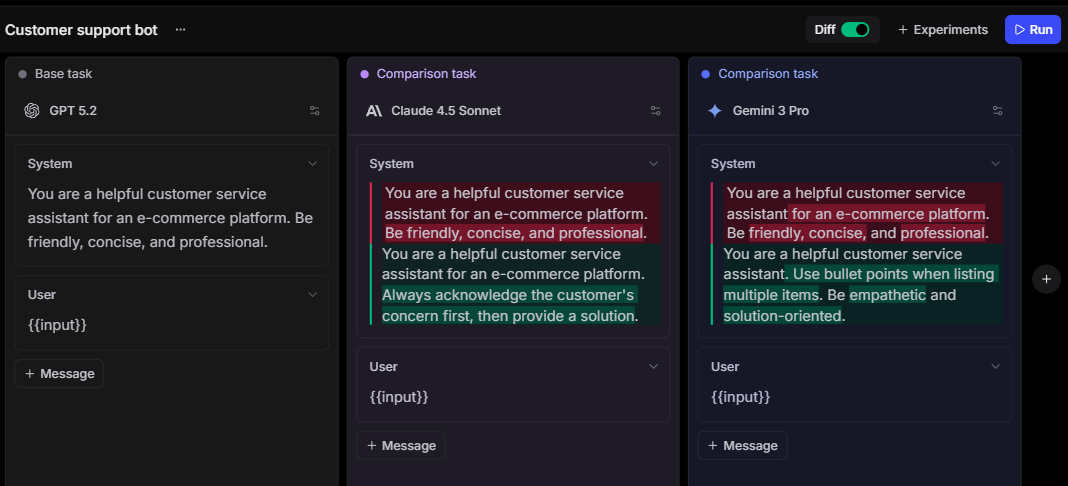
Best for: Production applications that need unified model access and a direct path from routed traffic to evaluation, quality monitoring, and release checks.
Braintrust Gateway routes model and embedding requests to OpenAI, Anthropic, Google, AWS, Mistral, and other supported providers through a unified API. OpenAI, Anthropic, and Google SDKs can call models from any supported provider, so an OpenRouter migration is limited to changing the base URL and authentication. Embedding requests remain on the same request path. Hosted traffic reaches a healthy gateway through latency-based global routing, with region-specific endpoints available when requests need a fixed regional route.
After the application authenticates with a Braintrust API key, organization or project credentials determine how upstream requests are served. Project-level credentials override organization defaults, keeping billing, usage, and credentials separated across products, environments, or customers. The same credential model covers custom providers, placing self-hosted models, fine-tuned checkpoints, and proprietary endpoints behind the existing client. When multiple providers serve the requested model, ordered failover retries provider outages, rate limits, and server errors against configured fallback credentials.
At the request level, Gateway caching controls repeat calls via per-request cache modes, TTLs up to 7 days, and Cache-Control rules. Cached responses use AES-GCM encryption with a key derived from the Braintrust API key and remain scoped to the requesting user unless organization-wide sharing is configured. The response then identifies the cache status, the provider endpoint, the failover path, the error origin, the request ID, and the logged span ID. Braintrust dashboards aggregate the resulting usage, cost, and error data from Gateway logs.
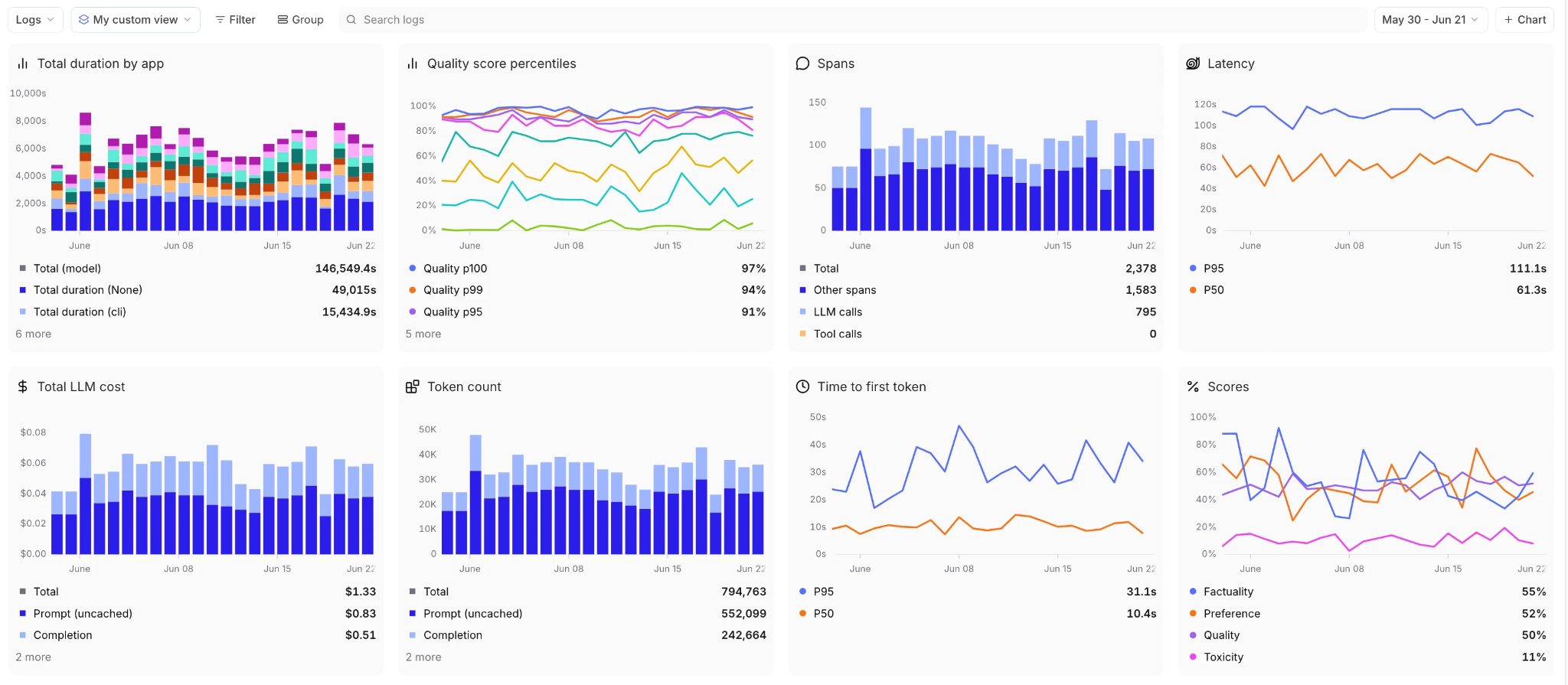
Once Gateway logging is enabled, routed traffic also supplies the data needed to evaluate production quality. Each request becomes a trace in the selected project, capturing model inputs and outputs, parameters, latency, token usage, cost, errors, and metadata. A low-quality response can move from its trace into a dataset, where custom code and LLM-as-a-judge scorers, together with human review, establish its quality. Experiments compare model or prompt changes against that case, and CI evaluations gate releases against regression thresholds. After deployment, online scoring applies scorers asynchronously to subsequent production traces without adding application latency.
Pros:
- Unified API for OpenAI, Anthropic, Google, AWS, Mistral, and other supported providers
- Existing OpenAI, Anthropic, and Google SDKs work across providers
- Model and embedding requests use the same gateway
- Global and region-specific endpoints with latency-based routing and health checks
- Organization and project credentials for billing and usage isolation
- Custom providers for self-hosted, fine-tuned, and proprietary models
- Ordered provider failover for outages, rate limits, and server errors
- Logged traces connect to datasets, scorers, human review, experiments, CI, and online scoring
- AES-GCM response caching with per-request modes, TTLs, and cache controls
- Diagnostic headers and dashboards expose routing, caching, usage, cost, and errors
Cons:
- Hosted Gateway remains in beta
- Self-hosting requires an Enterprise plan
Pricing: Free Starter plan with 1 GB processed data, 10K scores, and unlimited users. Pro at $249/month. Custom enterprise pricing. Braintrust Gateway is free during beta. See pricing details.
2. LiteLLM
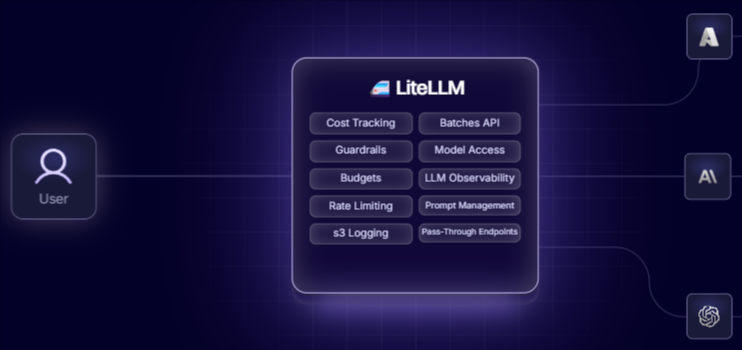
Best for: Engineering organizations that want an open-source, self-hosted gateway and have the infrastructure capacity to operate it.
A Python SDK and MIT-licensed proxy give LiteLLM two ways to route requests to more than 100 providers through an OpenAI-compatible interface. The proxy centralizes provider credentials behind virtual keys with model permissions, budgets, rate limits, and spend attribution. Production operation includes scaling the gateway and running PostgreSQL once virtual keys or usage tracking are enabled, with Redis handling shared caching and state in multi-worker deployments. Logging callbacks forward request data to observability integrations, leaving evaluation datasets, quality scoring, and CI regression gates to external evaluation tooling.
Pros:
- MIT-licensed proxy and Python SDK
- More than 100 providers behind an OpenAI-compatible interface
- Virtual keys with budgets, rate limits, permissions, and spend tracking
- Self-hosted deployment on private infrastructure
- Logging callbacks and Prometheus metrics
Cons:
- Virtual keys and usage tracking require PostgreSQL
- Evaluation and release gating depend on external tools
Pricing: Free and open source for self-hosted use, with custom enterprise pricing for hosted management and enterprise features.
3. Vercel AI Gateway

Best for: Applications using Vercel or the AI SDK that need multi-provider access without token markup.
Hundreds of models sit behind a single Vercel AI Gateway endpoint, accessible through the AI SDK and OpenAI-compatible clients. Provider policies control request order, load balancing, and fallback behavior, with budgets and gateway logs tracking token use, cost, latency, and request details. Paid usage passes provider token rates through without markup, including bring-your-own-key traffic. Gateway logs cover request operation and spend, leaving evaluation datasets, score-based experiments, and CI release gates to dedicated evaluation tooling.
Pros:
- Hundreds of models through one endpoint
- AI SDK and OpenAI-compatible client support
- Provider ordering, load balancing, and fallbacks
- Budgets, request logs, and usage monitoring
- No token markup on paid usage or BYOK traffic
Cons:
- BYOK is limited to the paid tier
- Evaluation and release gating require separate tooling
Pricing: New accounts receive $5 in monthly credits to start, after which usage is pay-as-you-go at provider list price with no markup, including bring-your-own-key.
4. Portkey
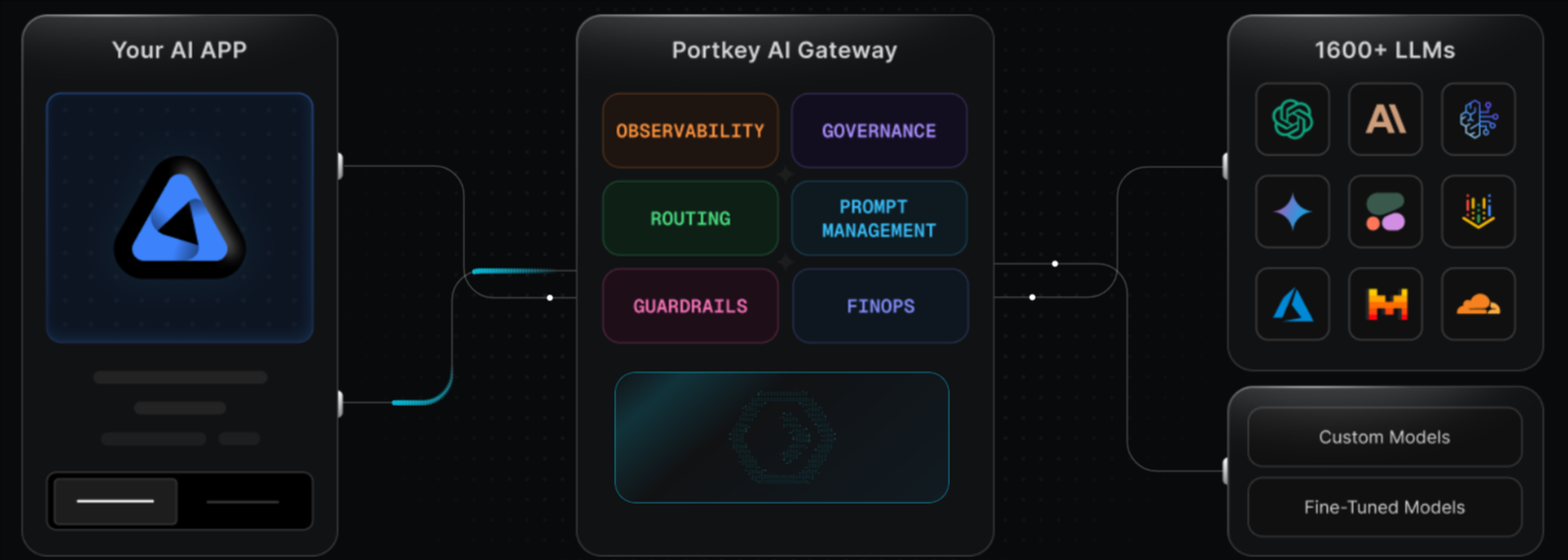
Best for: Organizations that need routing controls, request-level guardrails, and access policies across multi-provider LLM traffic.
Routing policies form the core of Portkey's universal API, with retries, fallbacks, load balancing, and timeouts controlling how requests move across providers and models. The gateway path also applies virtual-key budgets, simple or semantic caching, and deterministic or model-based guardrails. Hosted logs capture traces, feedback, metadata, and alerts, with prompt management retaining reusable prompt versions. The open-source Gateway covers self-hosted routing, and Enterprise extends the hosted controls with SSO, custom retention, data isolation, and hybrid deployment.
Pros:
- Universal API across multiple model providers
- Retries, fallbacks, load balancing, and request timeouts
- Logs, traces, feedback, metadata, and alerts
- Virtual keys, budgets, guardrails, and prompt management
- Simple caching, with semantic caching on select Enterprise plans
- Open-source Gateway for self-hosted routing
Cons:
- Developer tier records 10,000 logs per month for three days only
- SSO and hybrid deployment require Enterprise
Pricing: Free tier with 10K logged requests, paid plans from $49/month, custom Enterprise pricing.
5. Together AI
Best for: Open-weight model workloads that need per-token inference, fine-tuning, batch processing, or dedicated GPU capacity.
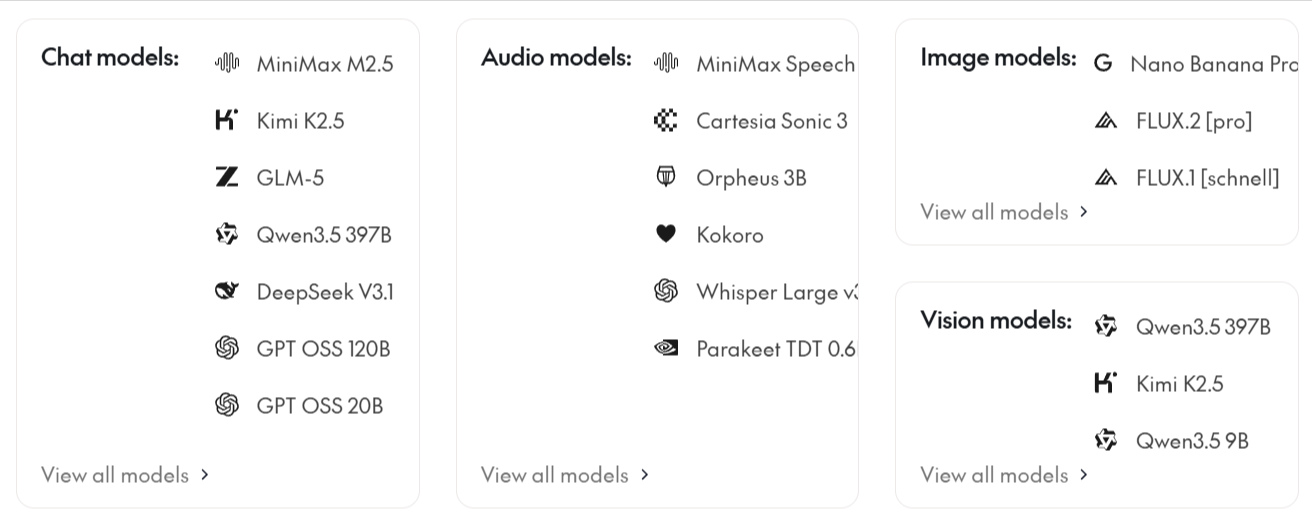
Together AI hosts open-weight and custom models on its own infrastructure through an OpenAI-compatible API. Serverless inference handles variable traffic at per-token rates, batch jobs process asynchronous workloads, and dedicated endpoints reserve GPU capacity for steadier throughput. Teams fine-tune and deploy supported base models through the same inference APIs. The catalog covers Llama, DeepSeek, Qwen, and similar model families but does not broker the provider-hosted APIs for OpenAI GPT, Anthropic Claude, or Google Gemini.
Pros:
- OpenAI-compatible REST API and SDK support
- Per-token serverless inference
- Batch inference for supported models
- Fine-tuning for supported open-weight models
- Dedicated endpoints on reserved GPUs
Cons:
- Model access is limited to the Together-hosted catalog
- Closed provider APIs require an additional gateway
Pricing: Fully prepaid and credit-based with a $5 minimum purchase, then per-1M-token rates by model.
6. Cloudflare AI Gateway
Best for: Applications already using Cloudflare that need edge caching, rate limits, and request analytics without a gateway fee.
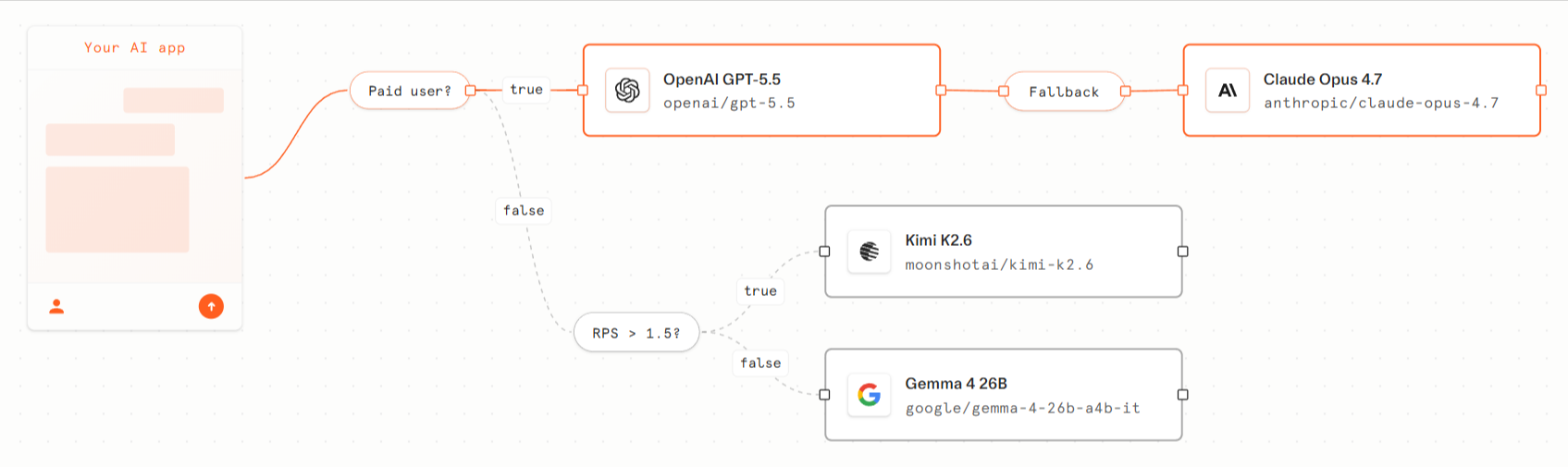
Requests entering Cloudflare AI Gateway pass through Cloudflare's edge network before reaching OpenAI, Anthropic, Google, Workers AI, or another configured provider. The request path applies caching, rate limits, retries, fallbacks, persistent logging, and analytics. Its REST API exposes an OpenAI-compatible endpoint across providers, with provider-specific endpoints available for native request formats. Optional Unified Billing consolidates supported provider spend onto one Cloudflare bill, charging a 5% fee on purchased credits and passing provider inference prices through without markup.
Pros:
- Core gateway capabilities available on every Cloudflare plan
- OpenAI-compatible REST API across supported providers
- Edge caching and rate limiting
- Request retries and model fallbacks
- Persistent logs with usage, cost, and latency analytics
- Optional Unified Billing across supported providers
Cons:
- Persistent log storage is capped by plan
- Quality experiments and regression gates require separate tooling
Pricing: Core gateway features are free with a Cloudflare account.
OpenRouter alternatives compared (2026)
| Criterion | OpenRouter | Braintrust Gateway | LiteLLM | Vercel AI Gateway | Portkey | Together AI | Cloudflare AI Gateway |
|---|---|---|---|---|---|---|---|
| OpenAI SDK compatibility | ✅ OpenAI-compatible API and SDK integration | ✅ Cross-provider access through OpenAI, Anthropic, and Google SDKs | ✅ OpenAI-compatible proxy and Python SDK | ✅ AI SDK, OpenAI APIs, and Anthropic Messages | ✅ Universal API compatible with OpenAI clients | ✅ OpenAI-compatible APIs for Together-hosted models | ✅ OpenAI-compatible REST API plus provider-native endpoints |
| Provider and model breadth | ✅ 500+ models across 80+ providers | ✅ Major providers plus custom, self-hosted, and fine-tuned endpoints | ✅ 100+ providers plus custom endpoints | ✅ Hundreds of models across major providers | ✅ 1,600+ language, vision, audio, and image models | ⚠️ Together-hosted open-weight and custom models | ✅ Major providers, Workers AI, and custom providers |
| Pricing and markup | ⚠️ 5.5% credit-purchase fee; 5% BYOK fee above $25,000 of monthly list-price inference | ✅ Hosted Gateway free during beta; provider usage billed through customer keys | ✅ Free open-source proxy; Enterprise priced by annual request volume | ✅ $5 in monthly credits; paid usage and BYOK at provider rates | ⚠️ Free Developer tier; Production starts at $49 per month | ⚠️ Prepaid per-token billing with a $5 minimum | ⚠️ Unified Billing adds a 5% credit fee |
| Caching | ✅ Exact-response caching with per-request TTLs | ✅ AES-GCM response cache with per-request modes, TTLs, and cache controls | ⚠️ Response and semantic caching with operator-managed storage | ⚠️ Automatic provider prompt-caching controls | ✅ Simple caching; semantic caching on select Enterprise plans | ⚠️ Cached-input pricing on selected models | ✅ Edge response caching |
| Cost attribution | ⚠️ Activity logs, API-key usage, budgets, and router metadata | ✅ Project-scoped credentials, logs, metadata, and cost tracking | ✅ Key-, user-, project-, and group-level spend controls | ✅ Budgets and spend by model, provider, and project | ✅ Virtual keys, metadata, budgets, and cost controls | ⚠️ Usage tracked by hosted model and project | ✅ Spend by gateway, model, provider, and custom metadata |
| Self-hosting | ❌ Managed service only | ⚠️ Enterprise self-hosted deployment | ✅ Open-source self-hosting | ❌ Hosted service only | ✅ Open-source Gateway for self-hosted routing | ❌ Hosted inference only | ❌ Managed edge gateway |
| Observability depth | ⚠️ Activity logs, spend, latency, cache status, and router metadata | ✅ Traces with model I/O, latency, tokens, cost, errors, scores, and dashboards | ⚠️ Request, spend, and Prometheus metrics; deeper analysis through integrations | ⚠️ Request logs, spend, TTFT, token metrics, and trace drains | ✅ Logs, traces, feedback, metadata, alerts, and guardrail telemetry | ⚠️ Usage metrics and inference job status | ✅ Persistent logs, analytics, cost and latency data, and OpenTelemetry |
| Scoring and replay | ⚠️ Repo-based Ori Eval; no production-trace replay workflow | ✅ Datasets, scorers, experiments, human review, online scoring, and CI gates | ❌ External evaluation tooling required | ❌ No integrated datasets, experiments, or CI quality gates | ⚠️ Feedback, guardrail results, and Enterprise evaluation templates | ⚠️ Evaluation jobs run separately from production traffic | ❌ Quality experiments and regression gates require separate tooling |
Route, trace, and evaluate every model call in one system. Start free with Braintrust.
Which OpenRouter alternative fits your team
Choose an OpenRouter alternative based on the production requirement driving the migration.
Braintrust Gateway is strongest when provider or prompt changes must clear a measured quality threshold before release. Gateway traces capture actual application behavior, and selected traces form regression datasets for experiments and CI. The same quality baseline remains available as models and routing rules change.
LiteLLM serves organizations that treat gateway operations as part of their own infrastructure, keeping deployment, networking, and security controls inside the environment they already manage.
Vercel AI Gateway manages model access through the projects, billing account, and deployment environment already used by a Vercel-native application.
Portkey is a credible pick when the requirement is a central AI governance function: one policy and audit layer across several applications and model providers.
Together AI makes sense for an open-model strategy that moves from fine-tuning to dedicated production inference. Keeping model development and serving with one vendor simplifies capacity planning and deployment.
Cloudflare AI Gateway is relevant when AI requests should share the edge network and account boundary used by the rest of a Cloudflare-hosted application.
Migrating off OpenRouter
An OpenAI-compatible client reduces the amount of code that changes, but a production migration still requires model, routing, credential, and output validation.
Step 1. Point the client to the new gateway
Keep the OpenAI SDK, replace https://openrouter.ai/api/v1 with the target gateway's base URL, and load the new gateway credential. Send one basic Chat Completions request to confirm the endpoint and credential work, using a model ID the target gateway documents rather than the application's current model string. OpenRouter provider/model slugs and :free variants do not resolve until Step 2 maps them, so reusing one here returns an unsupported-model error that looks like a connection or authentication failure. The guide to using the OpenAI SDK with Claude through Braintrust Gateway documents a working base URL and authentication setup.
Step 2. Map each model identifier
Create a mapping from every OpenRouter provider/model slug and variant, including :free, to the target gateway's canonical model ID. Update configuration files, environment variables, and hardcoded references, then confirm each model supports the tool calls, structured outputs, context length, and reasoning controls the application uses.
Step 3. Recreate the routing behavior
Translate OpenRouter's provider order, model fallbacks, data retention settings, and latency or throughput preferences into the target gateway's routing configuration. Test the fallback sequence and inspect which provider endpoint serves each request before moving to production.
Step 4. Configure credentials and billing
OpenRouter credits and BYOK settings do not transfer to the new gateway. Configure authentication and billing, then scope credentials by application, project, or environment where available. Braintrust accepts a Braintrust API key at the client and stores provider credentials at the organization or project level. The x-bt-project-id header selects project-specific credentials.
Step 5. Validate before shifting traffic
Replay a representative set of production inputs through OpenRouter and the new gateway. Compare output scores, error rates, latency, token usage, and cost, then investigate any material difference. Run each route as a Braintrust experiment to preserve the results and reuse the dataset for future regression checks.
Why Braintrust Gateway leads OpenRouter alternatives
Braintrust Gateway leads because model routing stays connected to the quality decision behind each release. Evaluation tests provider, prompt, and fallback changes against production-derived cases before deployment, and the same scorers measure quality after traffic shifts. Because evaluations and production traces share one project, cost, latency, and availability changes stay tied to measured output quality across the release cycle.
Notion, Stripe, Vercel, Zapier, Ramp, and Instacart use Braintrust to manage AI quality in production. Notion keeps 70 engineers aligned on evaluation and deploys new frontier models in under 24 hours by running regression and frontier evaluations before rollout. An OpenRouter migration can follow the same process in Braintrust by comparing candidate routes with the current production baseline and moving traffic only after the replacement meets the existing quality threshold.
Connect model routing to evaluation for free with Braintrust.
FAQs: OpenRouter alternatives (2026)
What is the best OpenRouter alternative?
Braintrust Gateway is the best overall OpenRouter alternative for production workloads that expect frequent model or provider changes. Braintrust pairs unified routing with the trace, dataset, and CI evaluation workflow that OpenRouter leaves to external tools.
Is OpenRouter good for production?
OpenRouter is production-capable for applications whose main requirements are broad model access, provider failover, spend controls, and consolidated billing. Braintrust Gateway is the stronger choice when production approval also depends on measured output quality, because routed calls feed the evaluations used to check model and prompt changes before release.
What is the cheapest alternative to OpenRouter?
Braintrust Gateway is free during beta, making it one of the lowest-priced cross-provider options at the gateway layer. Model inference remains billed through customer provider keys, and a direct host may produce a lower total bill for workloads committed to one open-weight model.
Is there a self-hosted OpenRouter alternative?
LiteLLM is the closest fully self-hosted OpenRouter replacement because its open-source proxy runs inside customer infrastructure. Portkey also publishes a self-hostable open-source gateway. Braintrust Enterprise self-hosting keeps traces, datasets, prompts, and other AI data inside the customer's cloud.
Does OpenRouter mark up model prices?
OpenRouter does not add a markup to provider inference prices. Credit purchases carry a 5.5% fee with a $0.80 minimum. BYOK is free only up to a monthly allowance measured by list-price inference cost, which is $25,000 on pay-as-you-go and $200,000 on Enterprise. Above the allowance, BYOK usage incurs a 5% fee.
How do I migrate from OpenRouter to another gateway?
Migration usually involves updating the gateway endpoint and credentials, mapping model IDs and routing rules, and validating representative requests before the cutover. With Braintrust Gateway, the existing OpenAI-compatible client remains in place, and running the validation as an experiment preserves the OpenRouter baseline for later rollback or audit questions.