How Box defines launch readiness with evals
With Matt Terrell, Director of Product Management, Box AI and Sidharth Srinivasan, Product Manager, Box AI
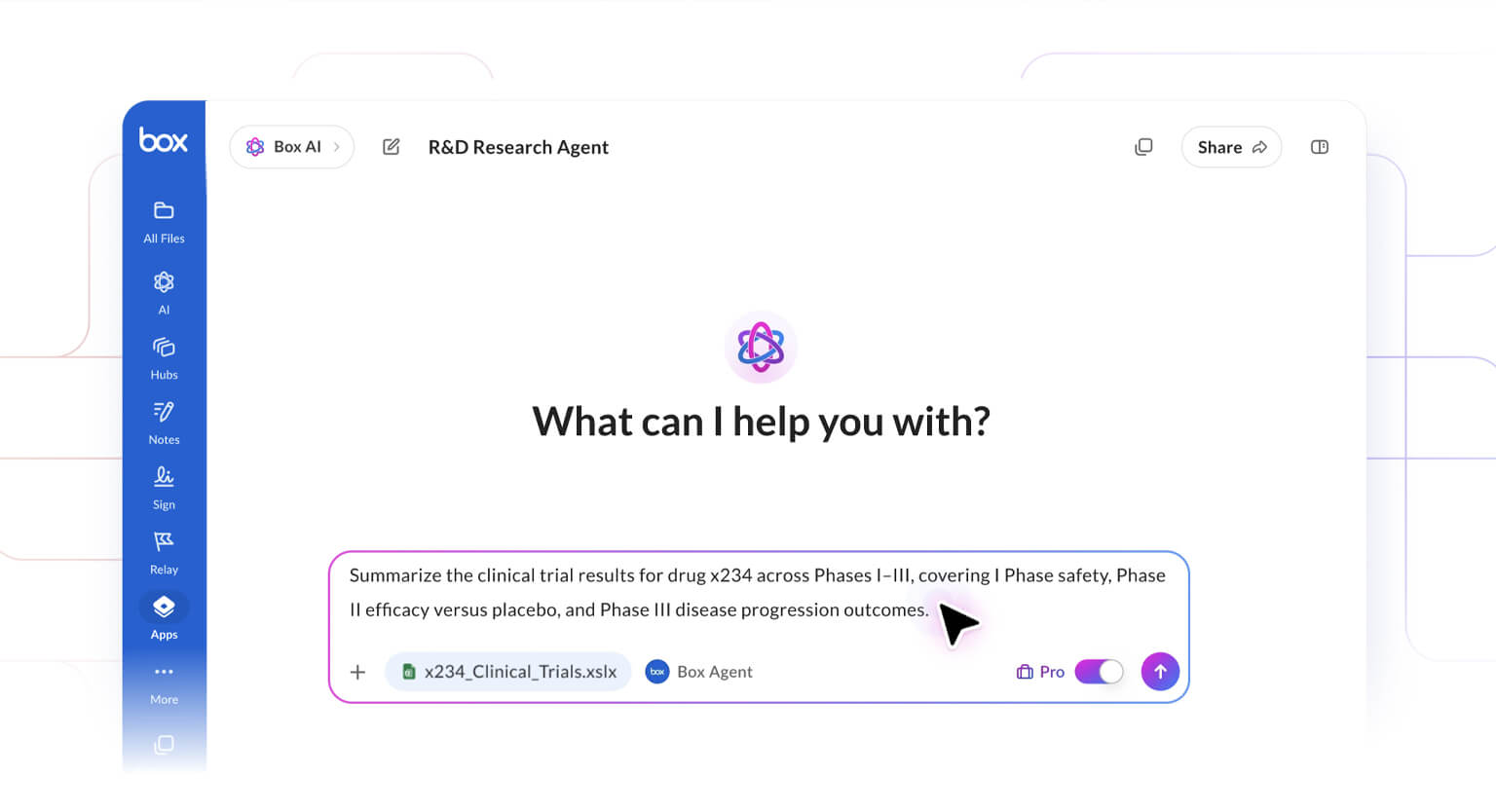
Box is the intelligent content management platform used by enterprises to store, secure, and make sense of their unstructured content. Box recently launched the Box Agent, which finds the right information at any moment, produces new content and saves it in the right place, and handles anything you would want to do with your files and folders.
Matt Terrell and Sidharth Srinivasan are product managers at Box who work on the eval infrastructure for the Box Agent. Their team built an eval practice in Braintrust that helps them curate datasets, design graders, and hill-climb the agent's quality, which helped them launch with confidence.
From spreadsheets to a system of record
Box's early evals were very manual. Team members logged into the product, typed a query, hit enter, waited, and marked the response in a spreadsheet or a Box Note. Then they did it again.
With Braintrust, they built a practice of running evals programmatically, overnight, every night. Now they can come back in the morning, see what regressed or improved and where, and spend the day on the highlighted issues.
Box's evaluation platform team developed a custom eval runner that pulls versioned, schema-validated datasets out of Braintrust, hits the agent endpoint, grades the outputs, and loads results back in. Because Box's content is so sensitive, the team needed its own tooling to keep isolation between Box and other vendors and ensure everything stays compliant.
Braintrust is our single source of truth for all of our datasets, all of our experiments, and all of the metrics we're tracking. When did this dataset change? Who created it? Is the schema correct? It solves a lot of those headaches.

Before Braintrust
Impossible to scale or repeat
The golden dataset as a launch roadmap
Box's path to launch was determined by datasets. Before opening the agent to internal dogfooding, the team built a set of roughly eighty questions covering core functionality and decided there would be no internal release until the agent scored above 80%. They ran these evals daily until it cleared.
Then they expanded these results into the golden dataset, a selection of about 330 questions representing every piece of functionality that should work at GA. Early scores sat in the sixty percent range, and that was fine, because the failures were legible and showed how to improve.
Tags in Braintrust let the team cluster these failure modes into useful categories. Some were feature gaps not yet implemented, but many were true quality problems. Braintrust made it possible to break these down by task type, like long-horizon deep-work tasks, or search tasks that needed to be more exhaustive.
Graders that check what a user would check
Box's grading philosophy starts with a question: if a human looked at this output, how would they decide it was correct? Then they moved on to finding the most robust way to check for exactly that.
PMs own each facet of the agent and write the test cases, including query, source documents, and a rubric of everything a correct answer must contain. An LLM judge ingests each rubric item individually and checks the output. But a general judge cannot verify everything users expect, so Box built specialized graders. A language grader with another LLM judge, scoped narrowly to expected versus actual language, and a citation grader that is pure code execution, with an expected file versus cited file, same or not.
The hardest problem they encountered was how to handle partial credit. An answer with four of five expected facts, well explained, looks good to a user, but the all-or-nothing system marked it a failure.
Tabbing through failures in Braintrust, question by question, and into the trace logs, is what surfaced the pattern.
If we didn't have a system of record, which is really what Braintrust became, this analysis would have been impossible.
One baseline, many models
Box is model neutral, both in its product and its public thought leadership. Matt and Sidharth work on and publish research about which models enterprises should use for which jobs. Braintrust makes these comparisons possible. The team uses the same dataset as a fixed baseline, runs parallel experiments across many different models, then compares each on accuracy, latency, cost, token use, and tool use.
That evidence shapes the product directly. Different models power different facets of the Box Agent, with extraction on one model and simple search tools on others. The team shares their findings as recommendations to customers, many of which are themselves building custom agents for legal, financial services, and data analysis use cases.
Evals are the new PRD
The most striking shift at Box is where evals sit in the product process. QA used to be the eleventh-hour chore before release. With AI, the eval is considered at the start of the product development lifecycle, and is built into the PRD itself.
PRDs from our PMs now include example eval questions. These eval sets are our opportunity to hand something to engineering and say: this is what we're looking to build, these are the queries that need to succeed, this is the definition of functionality for this release.
There is a boundary, though. Matt warns against having an LLM generate your eval set and then having an LLM judge it. This can create a closed circle that scores 100% and tells you nothing. Writing the evals is now the PM's job, and it still requires a human element.
The evals continue once the process moves to production. When negative responses cluster in composition, the team checks whether the eval set shows the same drop-off under the composition tag. If it does not, the eval set has a gap or its questions are too easy, and the offline suite gets stronger.
Key takeaways
- Datasets are critical before launch. A threshold dataset gates dogfooding, a golden dataset defines GA. Scores become a roadmap leadership can read.
- Tag everything. Failures clustered by feature gap and task type tell you where to hill-climb fastest.
- Match the grader to the check. Rubric-based LLM judges for semantics, code execution for citations, narrow judges for language. Check what a user would check.
- Put eval questions in the PRD. Defining the queries that must succeed is defining the feature.
- Don't let LLMs write and grade their own test. Eval creation is the human's job. Collation, pattern recognition, and analysis are where AI shines.
- Close the loop with production data. If customers struggle somewhere your evals don't, your evals are wrong, not your customers.
Thank you to Matt Terrell and Sidharth Srinivasan for sharing Box's story.
Define launch readiness with evals
Learn how Braintrust helps product teams build curated datasets, design robust graders, and establish the quality thresholds that make it safe to ship.
Read more customer stories
“Braintrust gave us deterministic answers about whether the agent is actually solving problems.”
How Notion evaluates AI at scale across 70 engineers
“Eval-driven development is the new test-driven development. Any projects that we take up, the first step is identifying the eval set.”