Best evaluation tools for conversational AI and multi-turn agents (2026)
Multi-turn evaluation measures whether an AI assistant follows instructions, responds to changing requirements, and resolves a request across an entire conversation. Choosing a tool requires looking beyond individual response scores to how the platform assembles conversation history, helps reviewers investigate failures, and tests whether an updated agent handles the same scenario correctly.
Braintrust is the best overall choice for production chatbots and support agents, combining conversation-level scoring, expert review, and regression testing in one workspace.
- Confident AI (DeepEval) suits Python teams building conversational tests around scenarios and expected outcomes.
- Langfuse fits teams that want open-source session tracking and control over conversation scoring.
- LangWatch combines simulated conversations through its Scenario framework with thread-level production monitors.
- Maxim AI fits product and QA teams running persona-based simulations through a visual interface.
- Galileo, now Splunk Agent Observability, suits organizations bringing agent evaluation into their Splunk operations.
- Opik by Comet pairs open-source thread tracking and conversational metrics with simulated-user testing.
What multi-turn evaluation means for chatbots and agents
Single-response scoring checks each reply in isolation. Multi-turn evaluation treats the whole conversation as the unit of measurement, asking whether the assistant retained earlier instructions, incorporated new information, and completed the task by the end. Scorers and human reviewers assess the complete exchange, including tool calls, alongside the quality of individual replies.
A support bot might receive brand-alignment scores of 50%, 50%, 50%, and 100% across four replies and still fully resolve the customer's request. The average brand score of 62.5% measures adherence to the response guidelines, while a separate resolution score establishes whether the conversation achieved its intended outcome. Keeping the scores separate prevents an average across replies from becoming a misleading measure of task completion.
Applications can capture a conversation as one trace containing all turns or as separate traces connected by a shared session ID. Either structure needs to preserve message order and relevant tool results so scorers and reviewers can follow how the assistant reached its final response.
The full history makes several failures easier to identify:
- Lost instructions: The assistant drops an early constraint, such as replying in Spanish, as the conversation grows or its context is compacted.
- Task mixing: An order number or account detail from one request carries into a different task within the same chat.
- Accuracy decay: Responses become less accurate in later turns, even when the assistant continues producing plausible answers.
- Ignored updates: The user changes a delivery address or preference, but subsequent replies or tool calls use the previous information.
- Late or missed handoff: The assistant continues an unproductive exchange after the conversation meets the product's escalation criteria.
In Laban et al.'s study, 15 LLMs tested on six generation tasks showed an average 39% performance decline when information arrived across multiple turns, compared with fully specified single-turn prompts. Early mistakes often persisted through later turns, so a test should score whether the assistant recovers from a misunderstanding as well as whether it reaches the right final answer.
AI conversation analytics helps identify common requests and recurring production issues that deserve test coverage. Multi-turn evaluation applies defined quality criteria to representative conversations, establishing whether an assistant handles the requests correctly and continues meeting requirements after a prompt, model, or agent change.
What to look for in a multi-turn evaluation tool
A useful demonstration should use a conversation from the product being evaluated, including its tool calls and a known failure. Assess seven capabilities against the same example.
Conversation grouping: The platform should assemble the application's existing trace structure into a conversation using a stable identifier. Check how it handles missing IDs, delayed traces, and sessions that resume after a pause.
Full-conversation review: A readable transcript should place user messages, assistant replies, tool calls, and scores in order. Reviewers also need access to the underlying trace evidence when a plausible reply hides an incorrect action.
Whole-conversation and per-turn scoring: A resolution judge needs conversation context, and a reply-level check needs the specific response being assessed. Inspect the actual scorer input and the scoring trigger. An idle timeout approximates a stopping point; an explicit end event depends on the application emitting it.
Failure discovery across conversations: Filters, conversation labels, and analysis by turn count should help identify recurring problems beyond existing scorer definitions. A product needs evidence of how frequently an issue occurs before deciding which failures to prioritize.
Human review and dataset feedback: Domain experts should be able to assess complete conversations, record corrections, and preserve reviewed examples for future tests. Review assignments and independent judgments become useful as the volume and consequences of decisions grow.
Regression tests and CI: A failed chat should become a reproducible test with an expected outcome. Testing a revised agent requires running the candidate against scripted or simulated user behavior; rescoring a saved transcript evaluates the transcript or judge. Inspect how score thresholds become failing CI checks and required merge checks.
Pricing and deployment at conversation volume: A conversation can contain many traces, spans, events, and scorer calls. Compare the billing unit, included usage, seats, retention, and deployment requirements against realistic monthly traffic, including tool-heavy chats and repeated evaluations.
The 7 best evaluation tools for conversational AI and multi-turn agents in 2026
1. Braintrust
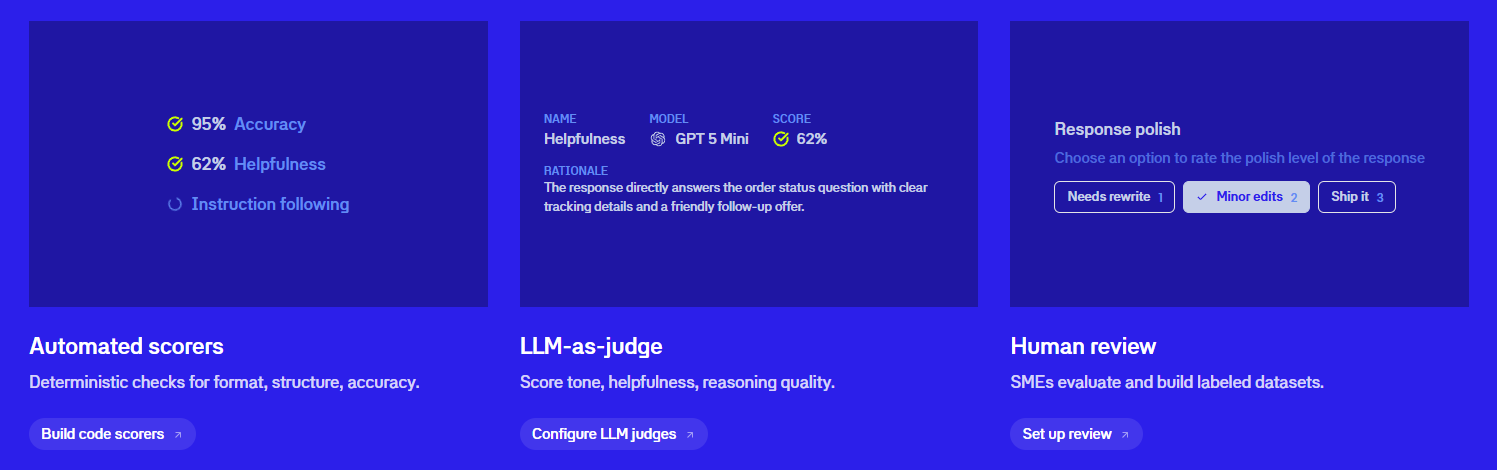
Best for: Engineering and product teams that need production conversation quality to determine whether agent changes are ready to ship.
Braintrust connects conversation evidence, automated scoring, expert judgment, and pre-release experiments in one evaluation platform. Engineers can inspect the failed turn, and support leads or product experts can judge whether the full exchange met the customer's needs. Shared datasets and acceptance criteria give both groups a consistent basis for approving changes.
Braintrust groups turns into one conversation
Braintrust accommodates both common logging patterns described above. A chat logged as one trace can use a session root span as the parent of each turn. An application that emits separate traces adds a shared field such as metadata.session_id, then groups related traces in Logs using the same field.
The thread view renders messages and tool calls as a conversation, with scores available alongside the trace evidence. Reviewers can follow the exchange in order and inspect the tool execution behind a response when the final answer alone does not explain a failure.
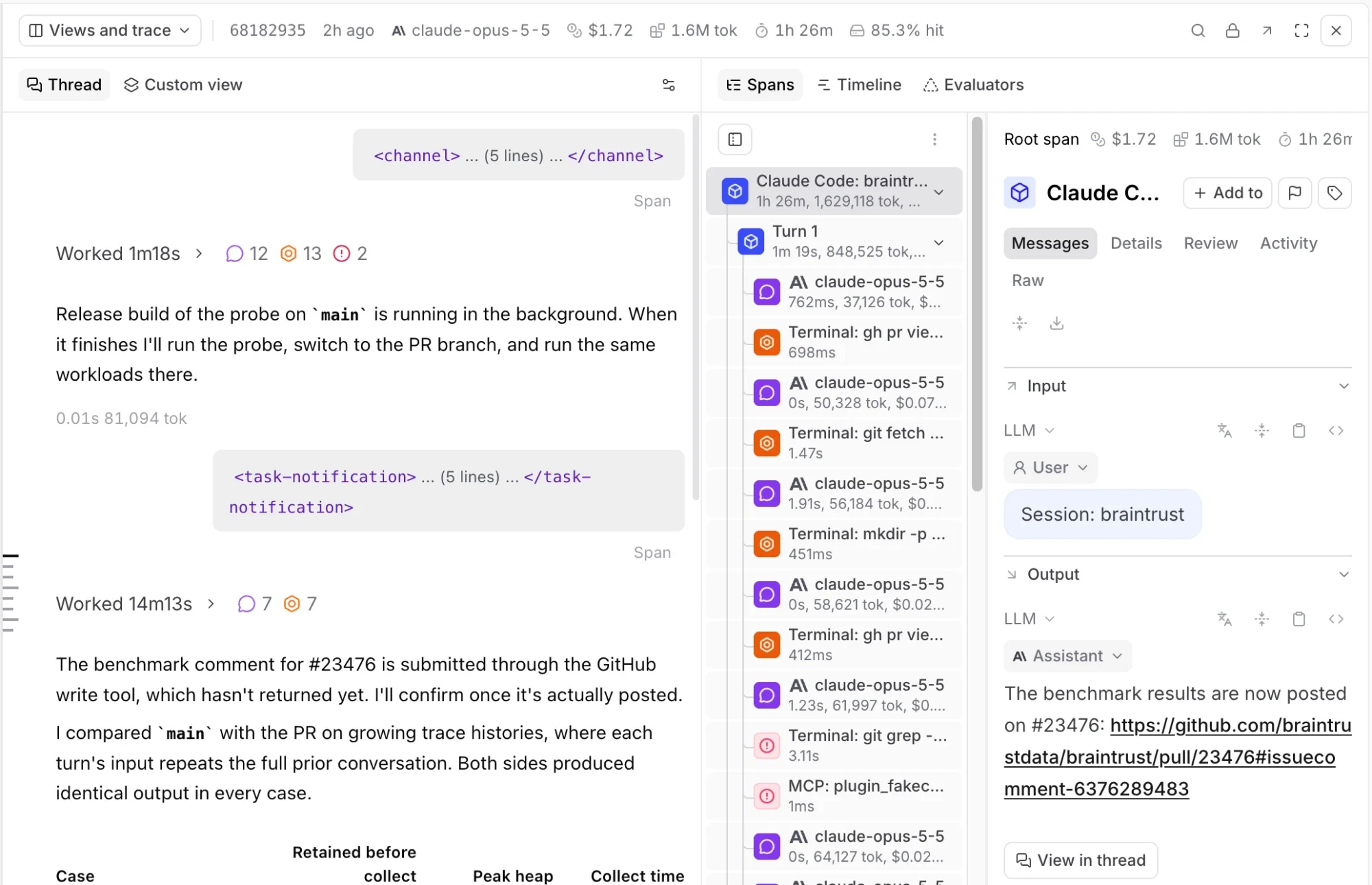
Scoring whole conversations and individual turns
Braintrust online scoring runs asynchronously at span, trace, or group scope. Span scope evaluates an individual response or tool call, trace scope evaluates an interaction captured in one trace, and group scope evaluates related traces using a field such as metadata.session_id.
Grouped scoring waits for an idle timeout, which defaults to 30 seconds. The group interval defaults to 24 hours and a group includes up to the most recent 64 traces, which is also the maximum. These limits apply to grouped online scoring, so the grouping configuration needs to match the conversation lengths being assessed. A rule can attach a rolling score to the first included trace or score each trace using the history available up to that point.
LLM-as-a-judge scorers can inspect the assembled conversation through {{thread}}, which renders the user and assistant turns as formatted text, or through {{thread_with_system}} when the rubric has to judge the agent against its system prompt. Custom code scorers can retrieve the rendered history with trace.getThread() and apply product-specific checks, such as verifying that a changed address appears in the eventual tool arguments.
Reusable scorers keep production and pre-release judgments aligned, so the judge that scores live conversations can grade a candidate agent's output in an offline experiment against the same resolution rubric.
Finding where conversations break down
Topics can group traces into conversations and classify each group as a single unit rather than classifying turns independently. Custom facets add labels relevant to the product, such as stale preferences, unresolved requests, or escalation outcomes. Classifying the full exchange keeps related turns together when measuring issue frequency.
Patterns, currently in public preview, investigates recurring behavior with supporting traces and suggested fixes. Loop, Braintrust's AI assistant, lets engineers and domain experts investigate a conversation, describe an evaluation requirement, and create datasets or scorers in natural language, which cuts the engineering work between a review finding and a measurable check.
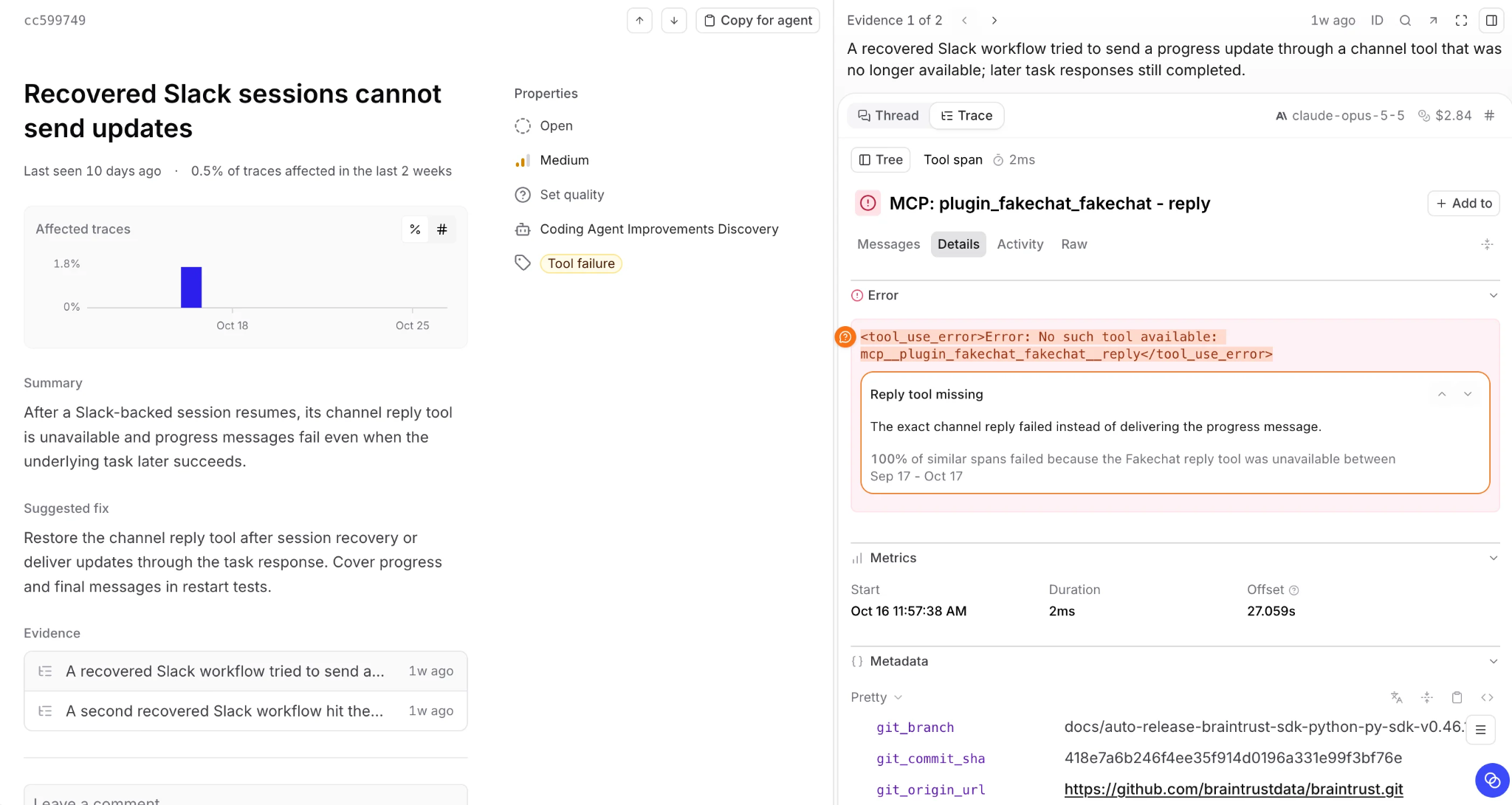
For length-related failures, record turn numbers in metadata and aggregate reply-level accuracy scores by turn count. A classifier can separately label handoffs as timely, late, unnecessary, or absent, making escalation outcomes filterable in Logs. Conversation length and task difficulty should be examined together before attributing a decline to context length.
Human review of full conversations
Braintrust human review accepts categorical, continuous, and free-form judgments. The thread view gives support leads and domain experts the conversation context, and review assignments route selected examples to the appropriate reviewers.
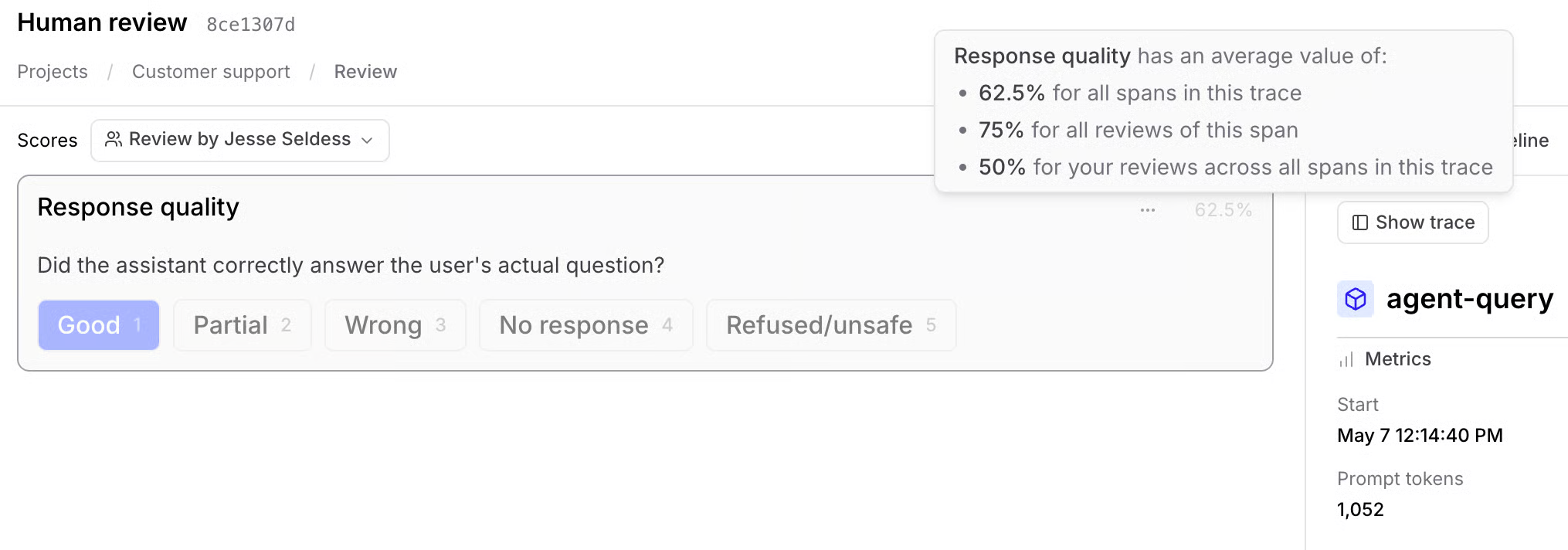
Blind reviews hide other reviewers' judgments to reduce anchoring, applying to every reviewer without the project Update permission. Human and automated scores remain associated with the relevant trace evidence, making disagreements inspectable. A reviewer can identify whether an incorrect resolution score reflects an ambiguous rubric, missing context, or an unreliable judge before the score becomes a release requirement.
Turning failed conversations into regression tests in CI
Reviewed examples can be promoted from Logs into datasets, preserving the evidence needed to reproduce a failure. For a new agent version, the evaluation task runs a scripted exchange or a user simulator against the candidate, then records the resulting conversation for scoring. A saved transcript alone is useful for validating a scorer, but testing changed agent behavior requires executing the agent.
Evaluation parameters expose application settings, including a handoff threshold or context-management strategy, for controlled comparisons. Engineers can prepare the runnable task, and reviewers can compare candidate settings against the same cases and acceptance criteria.
Braintrust's CI integration runs evaluations through braintrustdata/eval-action or bt eval and can post results on pull requests. A configured reporter returns a failure when scores breach the chosen thresholds, and a repository rule can require that check to pass before merging. Connecting evaluation results to required checks makes release enforcement explicit.
Pros
- Whole-conversation judgments and reply-level checks expose unresolved tasks and the specific turns that caused them.
- Both common trace structures work with session grouping, reducing changes to existing chatbot instrumentation.
- Thread view makes multi-turn exchanges readable for support leads, product managers, and engineers reviewing the same evidence.
- Asynchronous scoring evaluates live conversations without placing judge execution in the response path.
- Reusable scorers keep production monitoring and candidate evaluations aligned to the same quality criteria.
- Topics and custom facets quantify conversation failures by product-specific categories, helping prioritize the issues to test next.
- Human review connects domain judgments to the automated scores used for release decisions.
- Loop helps non-technical team members turn plain-language requirements into evaluation work with less engineering overhead.
- Dataset promotion, parameter comparisons, and CI integration preserve confirmed failures as repeatable release checks.
Cons
- Patterns is in public preview.
- Multiple custom human-review scores per project require Pro or Enterprise; Starter allows one per project.
Pricing: The free Starter plan includes 1 GB of processed data, 10,000 scores, and unlimited users; Pro costs $249 per month, with custom enterprise pricing available. See pricing details here.
2. Confident AI (DeepEval)
Best for: Python teams building conversational test suites and simulated chats before release.
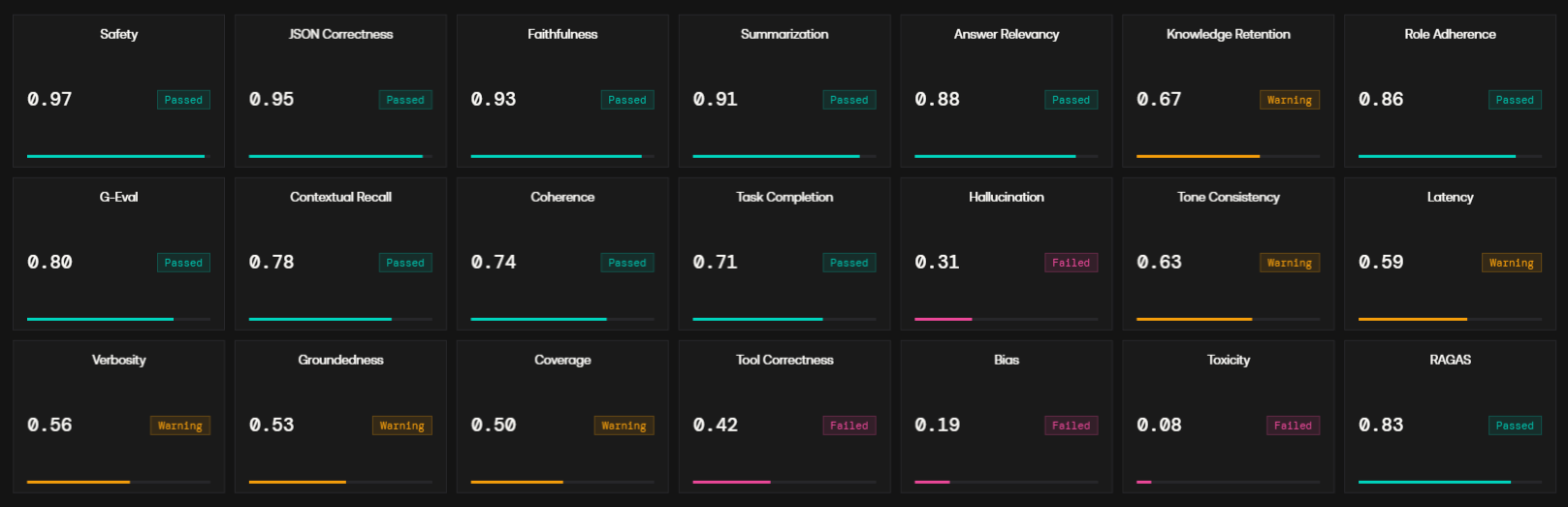
Confident AI is the hosted platform for the open-source DeepEval framework. DeepEval represents a conversation as a ConversationalTestCase containing Turn objects, with metrics for knowledge retention, role adherence, completeness, and turn relevancy. Its simulation tools generate exchanges from scenarios and expected outcomes. In production, Confident AI groups traces by thread_id and scores threads after a configurable idle period, 300 seconds by default, or an evaluate_thread call. Thread evaluation reads trace-level inputs and outputs, so the conversation evidence must be logged at that level. Thread annotations and conversational goldens connect review findings to development datasets.
Pros
- Open-source conversational test cases and metrics for Python test suites.
- Simulated chats test scenarios against the running chatbot.
- Automatic thread evaluation after an idle period, with an explicit SDK trigger available.
Cons
- Thread metrics exclude context recorded only in nested spans.
- Hosted thread evaluation and chat simulation require a paid plan.
Pricing: Confident AI offers a free tier limited to two seats, with paid subscriptions starting at $200 per month and custom Enterprise pricing.
3. Langfuse
Best for: Teams that want self-hosted session tracking and application-defined conversation scoring.
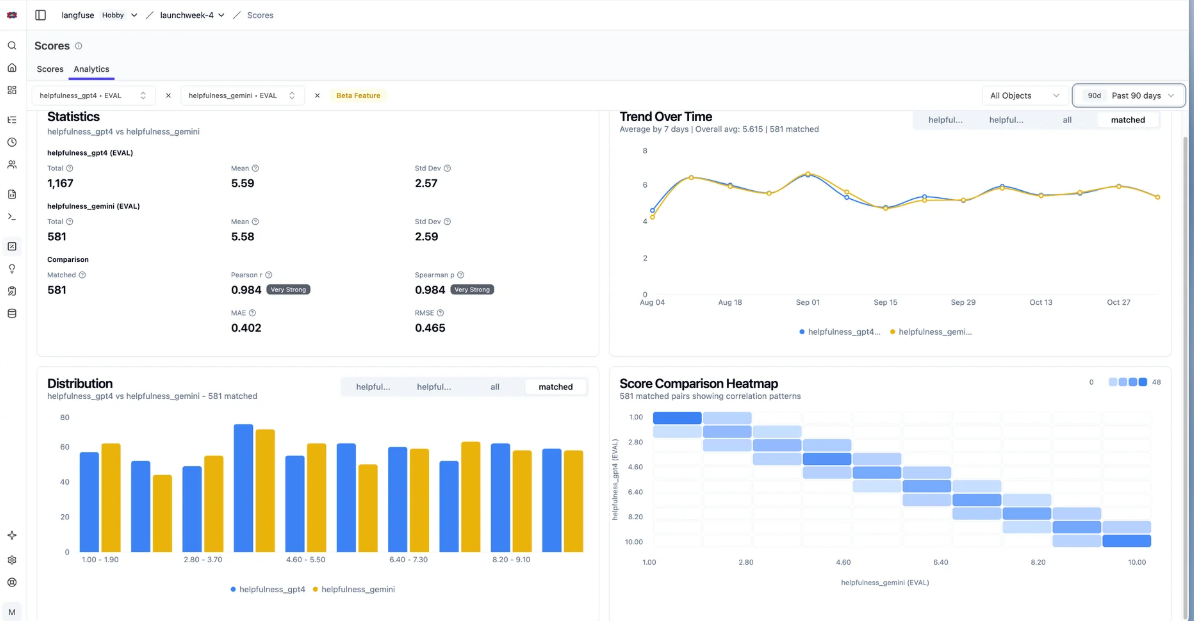
Sessions in Langfuse group traces through sessionId, with a replay view, session-level scores, and annotation queues. The MIT-licensed core covers tracing, prompt management, datasets, and evaluations. Automated LLM judges target observations containing the complete conversation history; session objects are not direct targets for those judges. An application can mark the final interaction to restrict evaluation to a completion point, or write custom session scores through the SDK. Langfuse suits teams prepared to control how conversation history reaches the evaluator.
Pros
- MIT-licensed core available for self-hosting.
- Session replay groups related interactions for review.
- Session annotations and SDK scores accommodate custom evaluation logic.
Cons
- Automated conversation judges require full history on the evaluated observation.
- Unlimited annotation queues require Pro or above.
Pricing: Paid cloud plans start at $29 per month, alongside a free Hobby tier limited to two users. Enterprise starts at $2,499 per month.
4. LangWatch
Best for: Teams combining agent simulations with thread-level production evaluation.
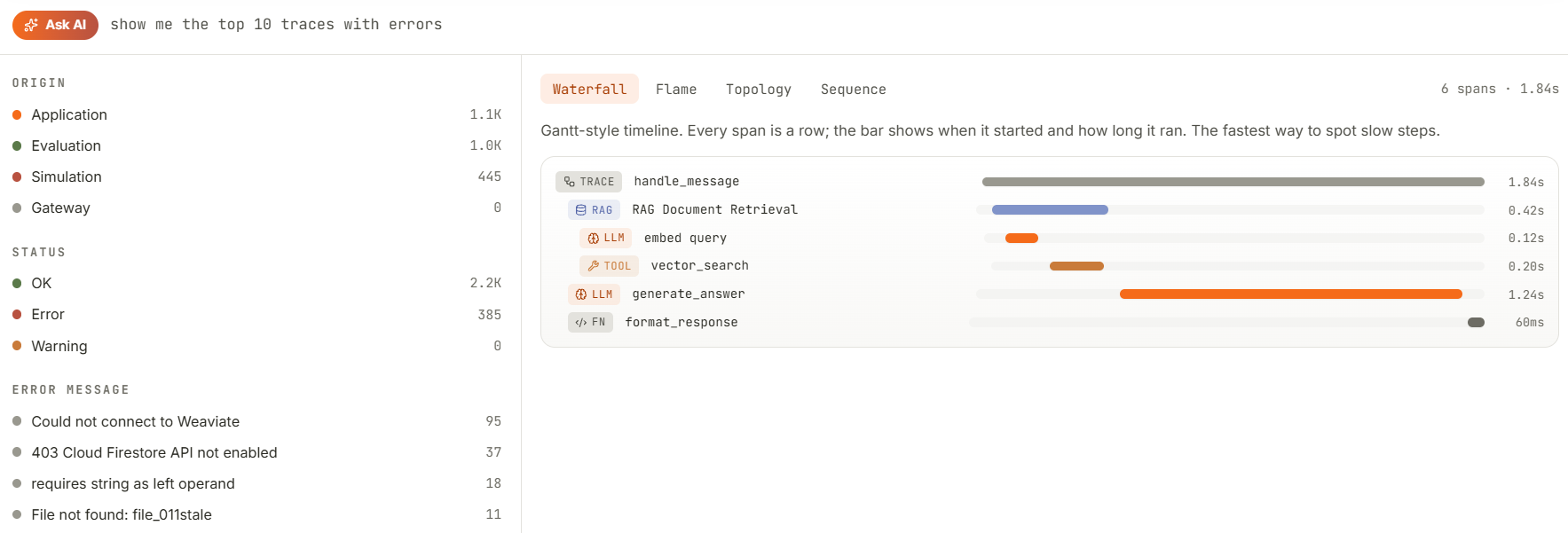
LangWatch combines tracing, evaluation, datasets, and the open-source Scenario testing framework. A thread-level production monitor assembles conversation context after an idle period (5 minutes by default, configurable from 1 to 30 minutes); disabling the timeout evaluates each incoming trace. Scenario runs simulated-user exchanges against an agent and uses a judge to assess natural-language criteria, with Python and TypeScript integrations for test runners and CI. Topic clustering and an annotation inbox help organize production review. Long conversations remain subject to the evaluator's configured context limits and truncation.
Pros
- Scenario tests multi-turn conversations through Python or TypeScript.
- Thread-level monitors score conversations after a configurable idle period.
- Open-source deployment is available for teams managing their own infrastructure.
Cons
- Free usage limits include 3 scenarios, 3 simulations, and 3 custom evaluations.
- Growth combines core-seat fees with event-based usage charges.
Pricing: Open-source self-hosting is free; Cloud Growth costs €29 per core seat per month plus usage, and Enterprise pricing is custom.
5. Maxim AI
Best for: Product and QA teams running persona-based simulations through a visual interface.
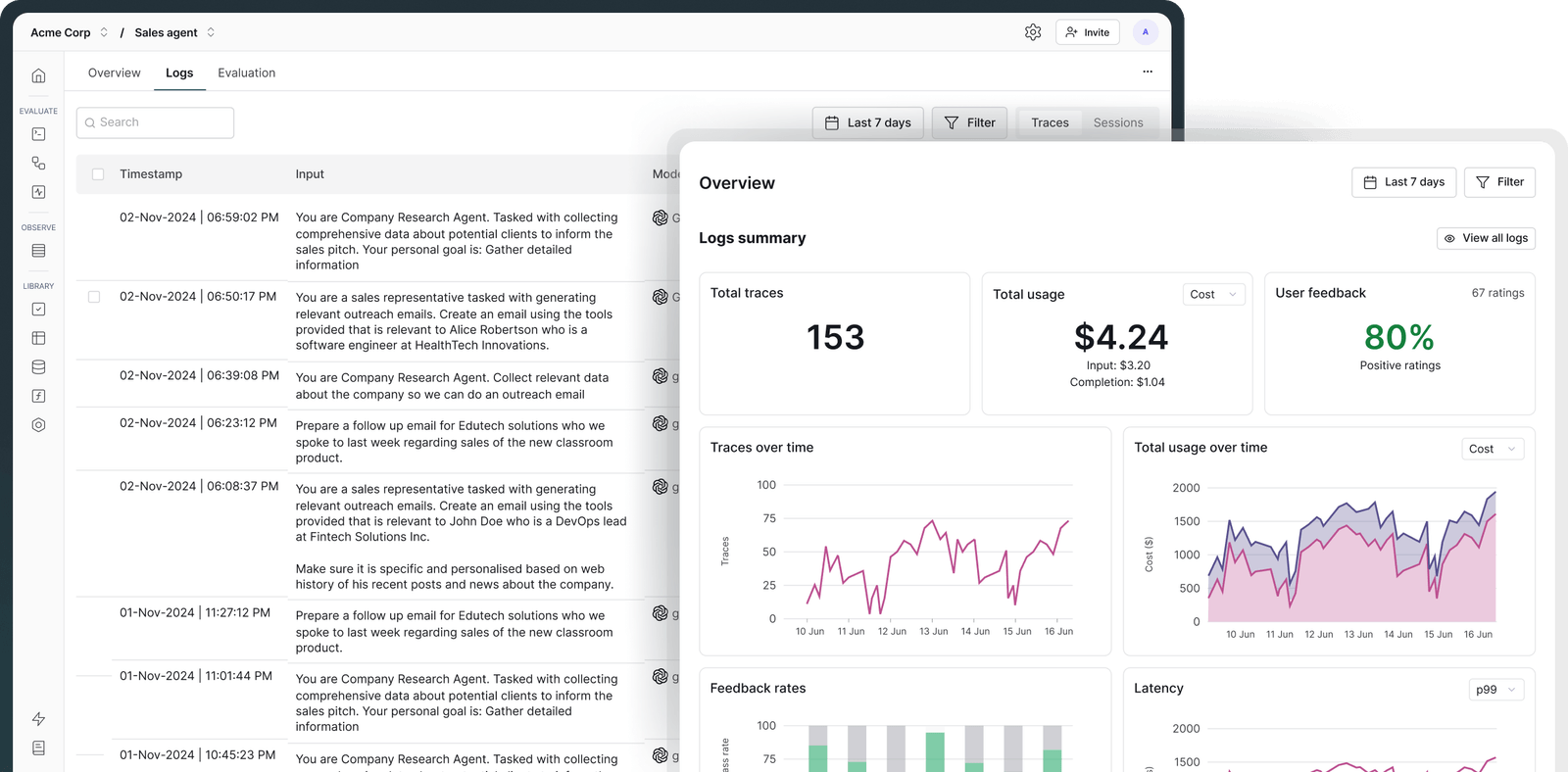
Maxim AI covers agent simulation, evaluation, and observability, with evaluation workflows for product teams that include test reports and dataset review. Its simulation engine tests scenarios and user personas against an agent, and production evaluators can operate at session, trace, or span level. Sessions group a conversation's traces, and session.end() triggers configured session evaluations. Human evaluation and log-based datasets connect production review to subsequent tests, with simulation and online evaluation available on paid plans. Applications need to close sessions explicitly for session-end scoring to run.
Pros
- Persona and scenario simulations exercise multi-turn agent behavior.
- Session, trace, and span evaluators assess different levels of an interaction.
- Visual test reports and human review fit product and QA participation.
Cons
- Session-end evaluation depends on the application's explicit end call.
- Retention is three days on Developer and seven days on Professional.
Pricing: A free Developer plan covers up to 3 seats. Paid subscriptions begin at $29 per seat per month, with Business at $49 per seat per month and custom quotes for Enterprise.
6. Galileo (Splunk Agent Observability)
Best for: Organizations using Splunk that want agent evaluation and runtime guardrails alongside existing observability operations.
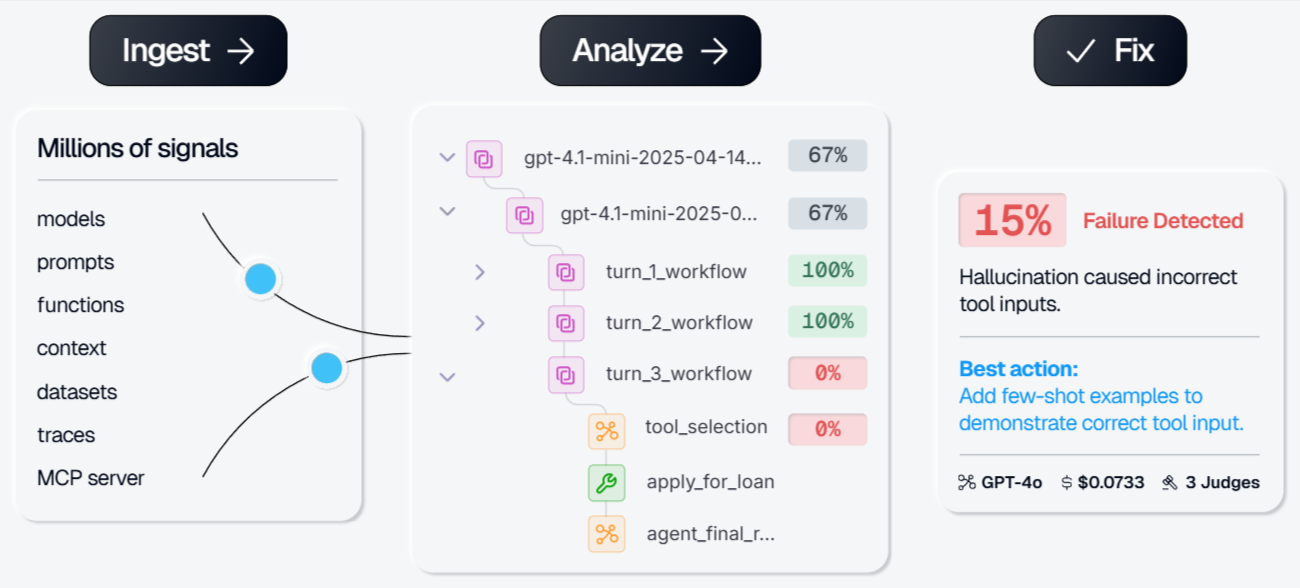
As part of Splunk, Galileo evaluates agent behavior at session, trace, and span level, with Luna models performing the scoring. Its agent metrics cover conversation quality, user intent changes, agent efficiency, and agent flow, plus session metrics that assess behavior across interactions; each requires different inputs depending on the metric. Runtime guardrails extend the same checks to agent inputs and outputs in production.
Pros
- Conversation and agent metrics assess behavior across sessions.
- Luna evaluator models run the automated scoring.
- Runtime guardrails complement evaluation and monitoring.
Cons
- Entry pricing requires annual billing.
- Span-based metering grows with nested LLM and tool activity.
Pricing: Pricing starts at $100 per month, billed annually, and includes 500 million Luna tokens and 5 Luna fine-tuning runs per year.
7. Opik by Comet
Best for: Teams seeking open-source thread evaluation and simulated-user testing.
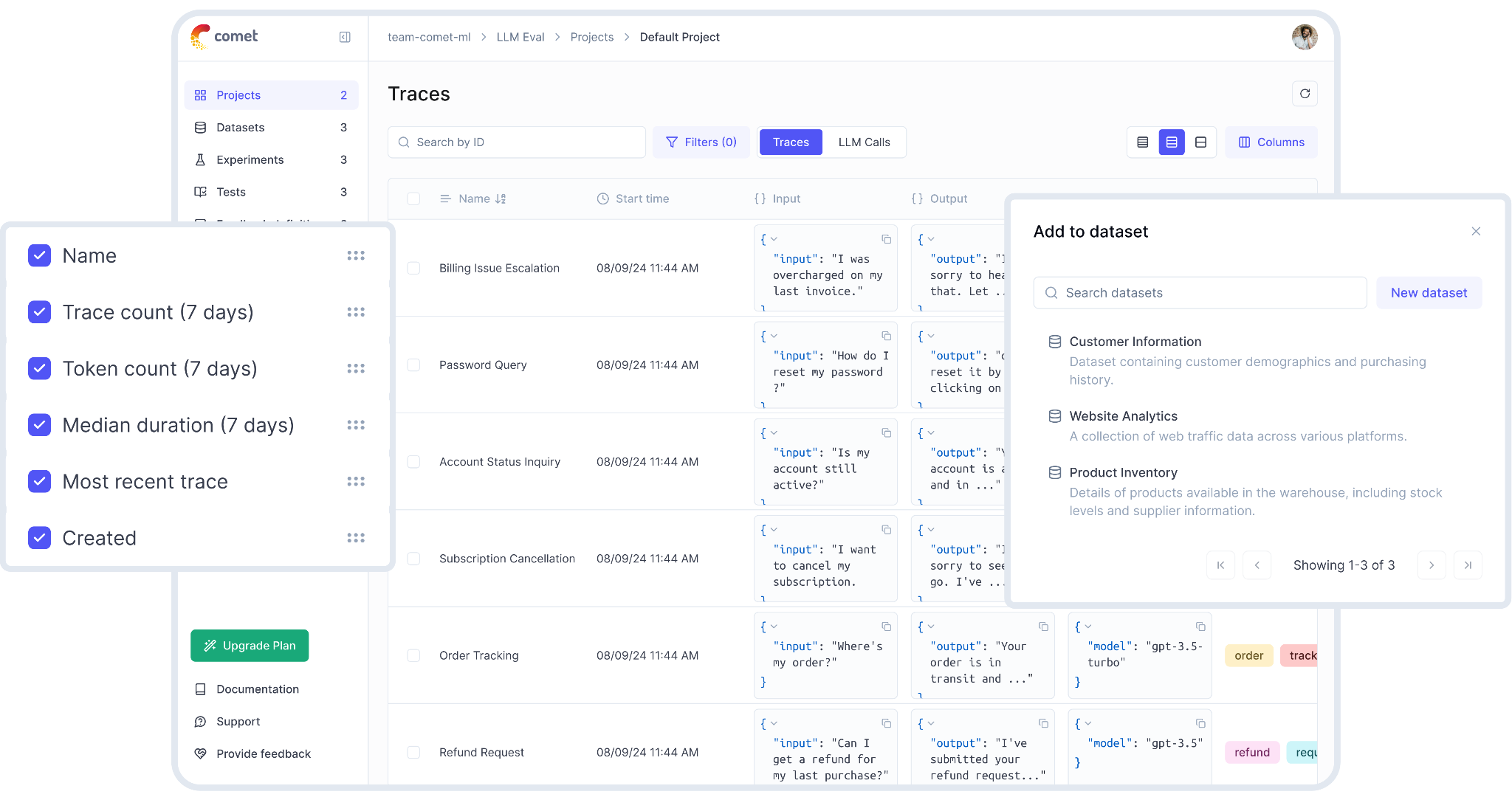
Opik is Comet's open-source observability and evaluation platform, with LLM evaluation available through its SDK and interface. Traces sharing a thread_id form a conversation, and thread-level online rules run after a cooldown that defaults to 15 minutes and is configurable at workspace level in Opik Cloud. Conversation metrics include coherence, user frustration, knowledge retention, and degeneration; evaluate_threads scores selected threads programmatically. The SimulatedUser class generates exchanges for pre-release tests, and annotation queues accept conversation-level feedback. The open-source core can be self-hosted, with hosted administrative controls and deployment services varying by plan.
Pros
- Open-source core available for self-hosting.
- Thread-level judges and conversational metrics evaluate complete exchanges.
- Simulated users and thread annotations cover pre-release testing and human review.
Cons
- Thread scoring waits for the configured cooldown after activity stops.
- Hosted SSO and enterprise access controls require Enterprise.
Pricing: Open-source self-hosting is available. Opik's free cloud tier covers 25,000 spans per month for up to 10 members, with a paid upgrade starting at $19 per month and Enterprise pricing set by contract.
Quick comparison: Best multi-turn agent evaluation tools (2026)
Conversation review and scoring
| Tool | Conversation grouping | Conversation view | Live conversation scoring | Multi-turn judging |
|---|---|---|---|---|
| Braintrust | Single trace or grouped traces | Thread view with trace evidence | Idle timeout; 30 sec default | LLM judges and code; trace or group scope |
| Confident AI | Shared thread ID | Thread view and metric results | Idle timeout; 300 sec default, or SDK call | Conversational metrics and custom judges |
| Langfuse | Shared session ID | Session replay | Judge on observation with full history | Judges on full-history observations |
| LangWatch | Shared thread ID | Thread and simulation views | Idle timeout; 5 min default, or each trace | Thread monitors and Scenario judges |
| Maxim AI | SDK sessions | Session view | Explicit session end | Session-level evaluators |
| Galileo / Splunk | Sessions of traces and spans | Session view | Session metrics | Conversation and agent metrics |
| Opik | Shared thread ID | Thread view | Cooldown; 15 min default | Thread judges and conversation metrics |
Failure analysis, human review, and regression tests
| Tool | Failure discovery | Human review | Regression tests |
|---|---|---|---|
| Braintrust | Topics, custom facets, Patterns preview | Thread review, assignments, independent scores | Datasets, experiments, configured CI gates |
| Confident AI | Thread metrics and filters | Thread annotation queues | Conversational goldens and DeepEval tests |
| Langfuse | Filters and dashboards | Session annotation queues | Datasets and experiments |
| LangWatch | Topic clustering | Annotation inbox | Datasets and Scenario in CI |
| Maxim AI | Filters; Business dashboards | Human evaluation | Datasets and CI integrations |
| Galileo / Splunk | Agent and session metrics | Expert annotations | Datasets and experiments |
| Opik | Thread metrics and filters | Thread annotation queues | Datasets and test suites |
Deployment and pricing
| Tool | Self-hosting | Entry offering | Starting paid price |
|---|---|---|---|
| Braintrust | Enterprise BYOC or customer-operated hosting | Free Starter: 1 GB processed data, 10,000 scores, unlimited users | $249/month plus usage; unlimited users |
| Confident AI | DeepEval open source; Enterprise hosting | Free: 2 seats, 1 project | $200/month; unlimited seats |
| Langfuse | MIT core | Free Hobby: 50,000 units, 2 users | $29/month plus usage |
| LangWatch | Open-source platform | Free: 50,000 events, 2 users | €29/core seat/month plus events |
| Maxim AI | In-VPC on Enterprise | Free Developer: 3 seats, 10,000 logs | $29/seat/month |
| Galileo / Splunk | Cloud or self-hosted deployment | $100/month, billed annually | $100/month, billed annually |
| Opik | Open-source core | Free Cloud: 25,000 spans, 10 members | $19/month |
How to choose a multi-turn evaluation tool for your chatbot
Evaluate the shortlisted platforms against a small, representative set of conversations before comparing subscription prices. Include a resolved request, a failed request, an updated user preference, and a conversation that resumes after a long pause.
1. Check the evidence reaching the scorer. Inspect the exact messages and tool results supplied to a conversation judge. Place a required instruction near the beginning of a long chat, then verify whether the judge receives it after the platform applies grouping windows, trace limits, or context truncation.
2. Test the stopping rule. Pause a conversation long enough to trigger idle-based scoring, then resume it and inspect the new result. For explicit-end scoring, test an abandoned chat as well as a normally closed session. Establish which record receives the score and how later activity changes the result.
3. Prove a failure is reproducible. Give a domain expert a known failure to review, preserve the expected outcome, and run a revised agent against the same scenario. A successful demonstration should show newly generated behavior, its score, and a failing CI result when the candidate violates a requirement.
4. Calculate the cost of the complete process. Count LLM calls, tool spans, evaluation runs, retention, and reviewer seats for the same traffic sample. Include the operational work needed for self-hosting and custom integrations, then compare the monthly cost at the expected conversation volume.
Why Braintrust leads on multi-turn evaluation
Braintrust gives conversation quality a defined role in release approval. Domain experts establish what resolution, instruction retention, and appropriate escalation mean for the product; engineers apply the agreed criteria to candidate changes. Unlimited users keep participation independent of seat budgets, so responsibility for the quality bar can remain shared across engineering, product, and support.
Cloudflare's Agent Experience team runs an LLM-as-a-judge over entire conversations to produce an overall resolution score for its dashboard agent, and breaks results down by product area. Skill, prompt, and recipe changes run through evaluation in CI, with regressions blocking release. The same benchmarks help assess sub-agents and model choices against the tasks they need to complete.
Schedule a Braintrust demo for conversational agent evaluation.
FAQs about conversational AI and multi-turn agent evaluation (2026)
What is multi-turn evaluation?
Multi-turn evaluation measures whether an assistant completes a task across an exchange, accounting for information introduced or changed along the way. A useful test distinguishes a correct final answer from a correct sequence of actions, since an agent may reach the expected answer after using stale details or taking an unauthorized step.
How do I run evals on multi-turn conversations?
Braintrust's Evals Foundations course builds and evaluates a multi-turn chat application end to end; the short version is to define a scenario, an expected outcome, and a conversation-level rubric, then run the agent through scripted or simulated user turns and score the resulting exchange. Include real production failures in the test set and retain a baseline for comparison.
How do I find the conversation length at which my assistant starts losing accuracy?
Measure accuracy by turn number, separate comparable task types, and require enough examples at each length. Harder tasks often produce longer chats, so a declining average alone does not establish a context-length problem. Braintrust SQL can aggregate logged scores and metadata to identify candidate failure points for controlled testing.
What evaluation tools help when an AI assistant forgets earlier instructions in long conversations?
Braintrust, DeepEval, and Opik can compare later replies with earlier requirements through conversation-aware scorers, and a Braintrust playground can run prompt variants against the same instruction-retention cases side by side. The cases themselves should place a constraint early and probe compliance after distracting turns or context compaction.
How can human reviewers be blended with automatic metrics for long-context agent conversations?
Have experts and automated judges score the same representative sample, then resolve disagreements and measure agreement by failure category. A judge may detect unresolved requests accurately and still miss late escalations. A human-in-the-loop evaluation process should preserve expert corrections to calibrate and recheck the judge.
How do I evaluate different confidence thresholds for handing an AI conversation to a human?
Calibrate confidence scores against observed outcomes first, so a given value means the same thing across scenarios. Then run the same labeled scenarios at each threshold and compare missed escalations, unnecessary handoffs, and time to escalation. Braintrust remote evaluations can run instrumented agent code at each threshold value for that comparison.
What should be on my checklist when demoing platforms for scoring multi-turn agent workflows?
Bring a conversation from your own product, including its tool calls and one failure you already understand, and ask the vendor to run that rather than a prepared sample. Note which plan tier sits behind each feature shown, since preview features and paid-only review tooling may not be in the plan under discussion, and read the usage meter at the end of the session so the cost estimate rests on recorded numbers.
Is Braintrust better than Confident AI for multi-turn evaluation?
Braintrust is the better fit when shared expert review and conversation-level acceptance criteria need to control production releases. Confident AI suits development centered on DeepEval's Python metrics and simulations.