

How to analyze AI conversations at scale: from raw transcripts to product insights
Analyzing AI conversations at scale starts with a specific product decision, such as identifying which recurring failure to fix or which feature request deserves attention. Collect conversations with session, feature, model, prompt version, feedback, and outcome metadata. After applying privacy controls and removing irrelevant traffic, classify known intents and outcomes, cluster conversations to uncover emerging patterns, and validate findings against source transcripts. Compare results across customer segments, features, and releases, then prioritize confirmed issues by frequency, severity, customer impact, and confidence.
Braintrust supports conversation analysis through structured tracing, Topics, Loop, human review, and evaluation datasets. Topics identifies patterns across tasks, sentiment, and issues, while Loop helps teams investigate findings using natural language. Validated failures become reusable evaluation cases, and online scoring helps track production quality. Product, engineering, and support teams can use the resulting evidence to prioritize improvements and measure their impact. Start free with Braintrust →
Why raw AI conversation transcripts fail as product evidence
Limited review coverage and missing context
A support assistant handling 2,000 sessions a day generates roughly 60,000 conversations in a 30-day month. A product manager reviewing 30 conversations daily covers less than 2% of that traffic, and the conversations colleagues forward tend to overrepresent conspicuous failures. Although manual review helps investigate individual interactions, a small, selectively shared sample cannot establish how often problems occur across the broader user base.
Even when product teams collect more conversations, meaningful comparisons depend on context that transcripts alone rarely provide. The exchange between a user and an assistant may not identify the prompt version, feature, account segment, or model responsible for the response. Without structured metadata, analysts cannot reliably compare similar interactions across releases or determine whether an increase in complaints coincides with a particular configuration change.
Distorted product priorities and missing outcome signals
Limited visibility into the broader conversation history can distort product priorities, particularly when an isolated failure receives attention during a planning meeting. A less visible issue may affect substantially more users or create greater customer impact, but its significance remains unclear without aggregate frequency, severity, and segment-level data. Product teams need evidence about the extent and consequences of recurring problems before deciding which improvements deserve engineering resources.
Measuring whether an AI assistant completes a task successfully adds another challenge because the conversation often ends before the final outcome becomes available. A transcript may capture the complete exchange without recording whether the user exported a document, escalated to support, abandoned the task, or returned with the same question. When completion events are missing or stored in separate systems without a shared session identifier, product teams cannot reliably connect assistant behavior to task outcomes.
Defining the product question before conversation analysis
Start with a decision the product team needs to make in the next planning cycle, such as which recurring failure deserves engineering resources or whether customer demand justifies a new integration. The analysis question should identify the evidence required to make that decision, with a measurable outcome and a clearly defined user population.
Write a testable question with a decision attached
A complete analysis question specifies the metric, population, segment breakdown, time window, and decision the results will inform.
For example:
"Among self-serve accounts in the last 30 days, what percentage of refund-request sessions ended in escalation? If the rate exceeds our predefined 20% threshold, should we prioritize investigating refund handling during the next planning cycle?"
The 20% threshold is illustrative and should reflect the team's actual service targets. Defining the measurement and decision criteria upfront establishes which metadata the analysis requires and when the findings are sufficient to inform prioritization.
Collecting AI conversations with the metadata analysis requires
The product questions defined earlier determine what each conversation record needs to include. Capture the relevant metadata when logging conversations, since missing identifiers, configuration details, and outcome signals can limit the comparisons available during analysis.
Session, user, and account identifiers
Use a session ID to connect the turns and events within a conversation, and a pseudonymous user ID to identify repeat interactions across sessions. Account-level metadata, including plan tier, tenure, region, and industry, supports comparisons across customer segments without requiring a separate CRM lookup for every analysis. Consistent identifiers also make it possible to connect conversations with subsequent support interactions or product outcomes. Collect only the identifiers and account attributes necessary for the analysis, with privacy controls applied before logging.
Feature, model, and prompt version tags
Record the configuration responsible for each response, including the feature surface, model name and version, prompt template version, retrieval index version, available tools, and A/B experiment assignment where applicable. Version metadata determines whether a quality change can be traced to its cause. When unresolved conversations rise after a prompt update, comparing affected sessions across versions requires knowing which prompt version produced each response, and the same records let analysts check whether shifts in user behavior or traffic composition contributed to the increase instead.
User feedback and outcome signals
Collect explicit feedback, such as thumbs-up and thumbs-down ratings, CSAT scores, and written comments, alongside behavioral signals such as repeated requests, retries, abandoned sessions, copied outputs, and escalations. Behavioral signals require interpretation because a retry or an abandoned session does not always indicate failure. Product outcomes may become available after the conversation ends. A completed checkout, exported document, or resolved support ticket should be associated with the relevant session ID so analysts can connect the interaction with its eventual result. Braintrust supports attaching ratings, corrections, and comments to existing traces through its user feedback instrumentation.
Logging architecture for conversation capture
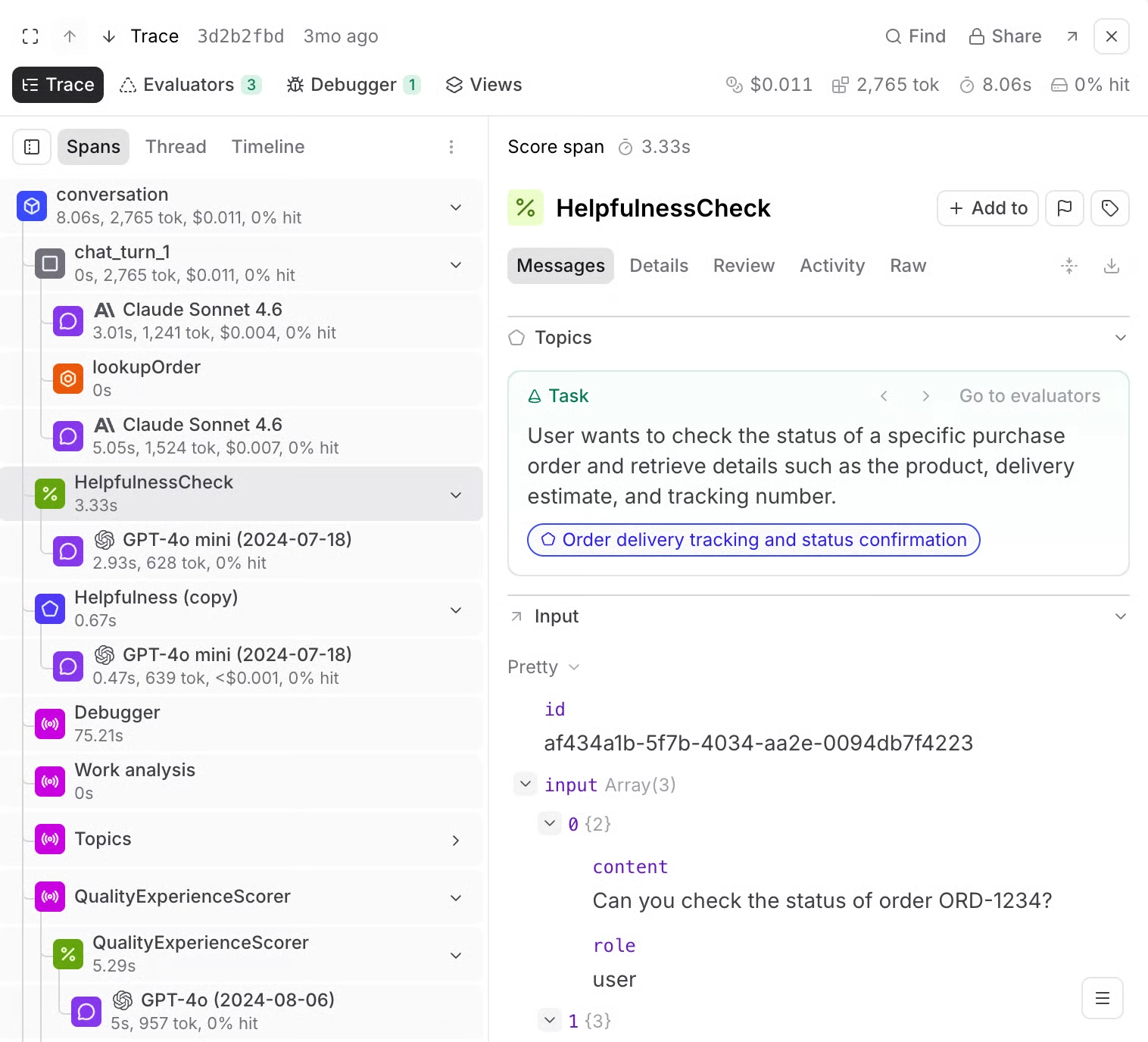
Use structured traces to preserve the sequence of interactions and the application operations behind them. Connect conversation turns through session identifiers and capture model calls, tool execution, and retrieval operations as spans where relevant. Braintrust's instrumentation supports nested spans with inputs, outputs, metadata, and execution metrics. Store configuration details and customer-segment attributes as structured metadata so analysts can filter and compare conversations without extracting information from transcript text. Preserve the relationships between conversation turns and application operations to support investigations that require more detail than the assistant's final response.
Also read: Best AI conversation analytics tools
Privacy review, redaction, retention, and sampling for conversation data
AI conversations can contain names, contact details, account information, financial records, and other sensitive information that users share during an interaction. Before connecting conversation data to analysis tools, establish which information the analysis requires, how it will be protected, and how long it will be retained. The privacy review should also address applicable requirements under GDPR, CCPA, HIPAA, or PCI DSS, depending on the data and the organization's obligations.
PII detection and redaction before analysis
Apply redaction before sensitive information enters the analysis platform. Braintrust's Python SDK supports a masking function that processes logged data before transmission, allowing teams to remove or replace information such as email addresses, phone numbers, payment details, and authentication credentials. Custom logging middleware can provide similar protection when additional preprocessing is required.
Consistent pseudonymous identifiers preserve the ability to connect sessions without storing raw user identifiers in every conversation record. Free-text content containing health information or other sensitive details requires additional review because automated masking may miss information that does not follow a predictable format. Pseudonymized records can also remain personal data under GDPR, so access and retention controls still apply.
Retention windows and access controls
Set retention periods based on the purpose of the analysis, applicable requirements, and the time needed to investigate failures. Raw conversations may need shorter retention than aggregate metrics, but classifications and derived records containing identifiable information remain subject to appropriate data protection controls.
Restrict access to raw transcripts based on job responsibilities, and maintain an audit trail where required. Braintrust's security documentation covers access controls, data residency, and deployment options for sensitive workloads. When a deletion request arrives, teams need to locate every affected copy and derived record, including evaluation datasets. Keeping source identifiers or dataset-origin metadata helps teams locate records that need review.
Excluding duplicates, test traffic, and low-value interactions
Remove irrelevant traffic from the analysis population before calculating conversation frequencies. Internal testing, synthetic requests, uptime checks, automated loops, and repeated retries can inflate the apparent frequency of particular intents or failures. Single-turn greetings without a substantive request may also be excluded when they contribute no information to the product question.
Tag excluded records with a reason so they remain available for authorized debugging when retention policies permit. Monitor the proportion of excluded traffic over time because unexpected increases may indicate instrumentation problems, duplicate events, or changes in application usage.
Stratified sampling versus full-corpus analysis
Classify the complete conversation corpus when processing costs and data volume permit. For larger datasets, stratify samples by relevant attributes such as feature, customer segment, and outcome so uncommon but consequential problems have adequate representation during analysis.
Sampling methods must also account for how conversations were selected. Oversampling rare failures improves their visibility, but population-level frequency estimates need appropriate weighting. Use larger samples when decisions require precise rates for individual segments, and report uncertainty when the available conversations cannot support a reliable estimate.
Classifying conversations by known intents and outcomes
Classification gives product teams a consistent way to measure what users request and how their interactions end. Separating intent from outcome lets analysts identify recurring problems across conversation types and compare results over time.
Step 1: Build the initial intent and outcome taxonomy
Define two sets of labels: intent describes what the user wanted, and outcome records what happened. Build the intent taxonomy using product features, support categories, and recent ticket data, keeping the initial set manageable and defining clear boundaries between similar requests.
Outcome labels can include resolved, partially resolved, unresolved, escalated, abandoned, and out of scope. Each label needs observable criteria, so the classifier applies it consistently. Include an unknown outcome when available signals cannot establish what happened, and maintain an "other" intent category for requests that existing labels do not cover. Monitor the share of conversations assigned to "other" to identify emerging needs that may warrant new categories.
Step 2: Classify conversations with rubrics and confidence scores
Give the classifier a rubric defining each label, supported by examples of typical and borderline conversations. The classifier should examine the relevant session context, including tool calls and results where necessary, and return an intent, outcome, brief justification, and confidence indication.
Route ambiguous or low-confidence classifications to human review, using the justification to identify where the model may have misinterpreted the rubric. Because model-generated confidence scores are not necessarily calibrated probabilities, establish review thresholds using performance on labeled examples.
Step 3: Measure classification accuracy against reviewed examples
Evaluate the classifier against a held-out set of human-labeled conversations covering common intents, uncommon cases, and categories the model frequently confuses. Have two reviewers independently label the conversations and resolve disagreements to establish consistent reference labels before measuring performance.
Track precision and recall for individual labels to identify misclassifications that aggregate accuracy can hide. Review the errors to determine whether the rubric, examples, or classifier need adjustment, then repeat validation whenever the taxonomy, model, or classification prompt changes. Expand the reference dataset as reviewers confirm new conversation patterns.
Clustering conversations to discover unknown patterns
Clustering helps product teams uncover recurring requests and failure modes that the existing taxonomy does not capture. Start with conversations assigned to "other" or flagged for low classification confidence, then examine the broader corpus when established categories may contain distinct problems.
Embedding and clustering approaches for conversation data
Summarize each conversation according to the product question before generating embeddings. Embedding raw transcripts can group conversations by shared vocabulary or broad subject matter, even when users encounter different problems. A focused summary, such as "What did the user want?" or "What went wrong in the assistant's response?", gives the clustering algorithm analysis-relevant information.
Braintrust's guide to custom facets for agent traces explains how preprocessing and focused prompts extract specific dimensions from production traces.
The resulting summaries can be embedded and grouped using methods such as HDBSCAN, k-means, or hierarchical clustering. Select the method according to the dataset and clustering requirements, then use an LLM to propose descriptive labels from representative conversations in each group.
Naming, merging, and splitting clusters
Review conversations from the center and boundaries of each cluster to determine whether they represent a consistent user need or failure mode. A label such as "Refund request blocked by missing order lookup" identifies a more specific problem than "Refund issues" and gives product teams a clearer starting point for investigation.
Merge clusters when they represent the same underlying problem and require the same product change. Split clusters when conversations reveal distinct causes or responsibilities. Billing conversations involving retrieval failures and response-formatting errors may belong in separate groups, since one needs an engineering fix and the other a prompt change.
Validating clusters with human review
Treat automatically generated clusters as hypotheses until reviewers confirm that their conversations belong together. Assign representative traces to a human review queue, where reviewers independently assess cluster coherence, naming, and overlap with existing categories.
Resolve disagreements by inspecting the source conversations and refining cluster boundaries. Once validated, recurring patterns can become taxonomy labels, allowing subsequent classification runs to measure their frequency. Preserve references to the source conversations so stakeholders can examine the evidence behind each finding.
Braintrust's guide to Topics explains how facet summaries are embedded, grouped into clusters, and assigned generated labels that appear in the Logs table for further analysis.
Trend analysis across time, segments, features, models, and prompt versions
Once conversations have validated intent, outcome, and issue labels, product teams can combine the classifications with structured metadata to measure how user behavior and assistant performance change over time. Comparing the share of affected conversations across consistent populations distinguishes recurring problems from isolated incidents and shows where further investigation is needed.
Time-series views for regression detection
Track the daily share of conversations assigned to each outcome or issue cluster, and annotate deployments to identify changes that coincide with prompt or model updates. For example, if the share of conversations involving failed refund requests doubles within 24 hours of a deployment, compare the affected sessions with the previous version and inspect the underlying traces before attributing the increase to the update.
Use a consistent historical baseline and apply the same segment filters across comparison periods. A two-week baseline can provide an initial reference, while weekly views help account for weekday vs. weekend traffic differences. For a fuller treatment of tracking production quality against deployment and configuration context, see Braintrust's LLM monitoring guide.
Segment and feature breakdowns
Compare intent and outcome distributions across plan tiers, account tenure, regions, and product features to identify problems hidden by aggregate metrics. An overall resolution rate of 85% could conceal a 60% rate among enterprise accounts using a particular feature. Breaking down the results reveals which customer groups experience the problem and how their outcomes differ from the broader population.
Segment-level analysis also shows where unmet feature demand originates. Comparing the number of affected accounts, request frequency, and customer characteristics provides evidence for roadmap and packaging discussions. Use consistent outcome definitions and check sample sizes before drawing conclusions about smaller segments.
Comparing model and prompt versions by outcome
Evaluate model and prompt versions using the same intent categories, outcome definitions, and comparable customer populations. Compare resolution and escalation rates over equivalent periods, accounting for differences in traffic composition and deployment conditions. Where versions serve different populations, investigate the differences before attributing outcome changes to the model or prompt.
Version comparisons can also inform model routing decisions. If two models achieve comparable resolution rates for a particular intent, their latency and cost may help determine which configuration to use. Agentic applications add tool calls and individual execution steps to the picture; Braintrust's guide to AI agent analytics tools walks through examining those alongside conversation outcomes.
Ranking findings by frequency, severity, customer impact, and confidence
Trend analysis can reveal more conversation patterns than a product team can address in a single planning cycle. A consistent prioritization framework scores each finding on prevalence, consequences, customer impact, and supporting evidence, so teams compare candidates on the same terms.
Scoring framework
Evaluate each finding across four dimensions using a consistent one-to-five scale:
-
Frequency: How often the issue occurs within the relevant conversation population.
-
Severity: How seriously the issue affects the user's ability to complete a task, from minor formatting problems to incorrect answers with significant consequences.
-
Customer impact: Which accounts and customer segments are affected, considering the number of affected customers and their business importance.
-
Confidence: How strongly the evidence supports the finding, based on classifier performance, cluster validation, and sample size.
Multiply the four ratings to create a comparative priority score.
Treat the scores as a consistent discussion framework, with rating definitions agreed upon before scoring begins. Serious safety, compliance, or customer-impact issues may require immediate investigation regardless of their calculated priority.
Confidence thresholds and sample-size requirements
Establish minimum evidence requirements before including findings in a prioritized roadmap. Consider the number of affected conversations, classifier precision for the relevant label, reviewer agreement, and how well the sample represents the customer population being analyzed.
Findings with insufficient evidence should remain visible on a watch list with a clear validation task and review date. When reporting frequency estimates, account for sample size and uncertainty within each segment so small or unrepresentative samples do not create misleading comparisons.
Separating product bugs, prompt issues, and user education gaps
Investigate the underlying cause of each validated finding before assigning ownership. An order lookup timeout may require an engineering fix, while incorrect answers could originate from prompt instructions, retrieval failures, or outdated source information. Repeated requests for an existing but difficult-to-find feature may indicate a discoverability or user education problem.
Use the source conversations and relevant application traces to establish the cause, then assign the finding to the appropriate team. Clear ownership connects the prioritized evidence with the work required to resolve the issue.
Turning validated findings into product and engineering actions
Validated findings become useful when they lead to specific product decisions, engineering fixes, or support improvements. Assign each finding an owner, document the supporting evidence, and define how the team will measure whether the resulting change resolves the problem.
Roadmap inputs and PRD evidence
Create a one-page evidence card for each finding that requires a product decision. Include the cluster name, frequency and trend over the previous eight weeks, affected customer segments, root cause, priority score, and three representative conversations linked to their source records.
Product managers can use the card to support a proposed feature or improvement in a product requirements document (PRD). The linked conversations give engineers and designers direct access to the original user experience, while the frequency and customer-impact data establish the scope of the problem. Record the proposed action, responsible owner, and success metric so the finding can be evaluated after implementation.
Prompt and model changes with before-and-after measurement
Turn conversations from a validated failure cluster into evaluation cases before changing the prompt or model. Run the proposed configuration against the resulting dataset, check that the targeted failures improve without introducing regressions, and use the evaluation results to inform the release decision.
After deployment, track the affected cluster's share of production conversations alongside the relevant quality scores. If the failure remains prevalent, examine the new traces to determine whether the change addressed the original cause or whether additional problems require investigation. Deployment comparisons and CI-enforced quality gates are covered in more depth in Braintrust's guide to LLM call observability.
Support workflow and escalation updates
Route findings involving unresolved requests and repeated escalations to the support team, with the affected intents and representative conversations attached. Support leads can use the evidence to update response templates, revise escalation criteria, and improve guidance for requests the assistant consistently struggles to resolve.
For severe or recurring failures, configure quality alerts to notify the responsible team when production scores or error rates breach established thresholds. Alerts should identify the affected workload and link to the underlying traces, so support and engineering teams can investigate promptly.
New evaluation dataset cases from production failures
Preserve validated failures as regression cases with representative inputs, verified expected behavior, and scorers that check whether the problem has been resolved. Select enough examples to cover the variations within each cluster, including cases where the assistant previously produced correct results.
Braintrust's dataset pipelines can transform filtered production spans or traces into dataset rows in bulk, reducing the manual work involved in maintaining regression coverage. Review the generated rows and correct their expected values before adding them to the evaluation suite. Retain source identifiers where permitted so teams can investigate the original failure and locate related dataset records when necessary.
Run the updated evaluation suite against subsequent prompt, model, and retrieval changes as part of the release process. Previously identified failures then remain covered by repeatable tests, giving engineering teams a consistent way to detect their recurrence.
Analyzing AI conversations at scale with Braintrust
Braintrust puts the evidence from AI conversations in one place, so product, engineering, and support teams work from the same traces when deciding what to improve. Applications instrumented with the Braintrust SDK or OpenTelemetry log production conversations as structured traces that keep the tool calls, retrievals, and metadata needed to investigate recurring problems. Sensitive information should be masked before ingestion, and a custom preprocessor controls which logged content reaches the classification models.
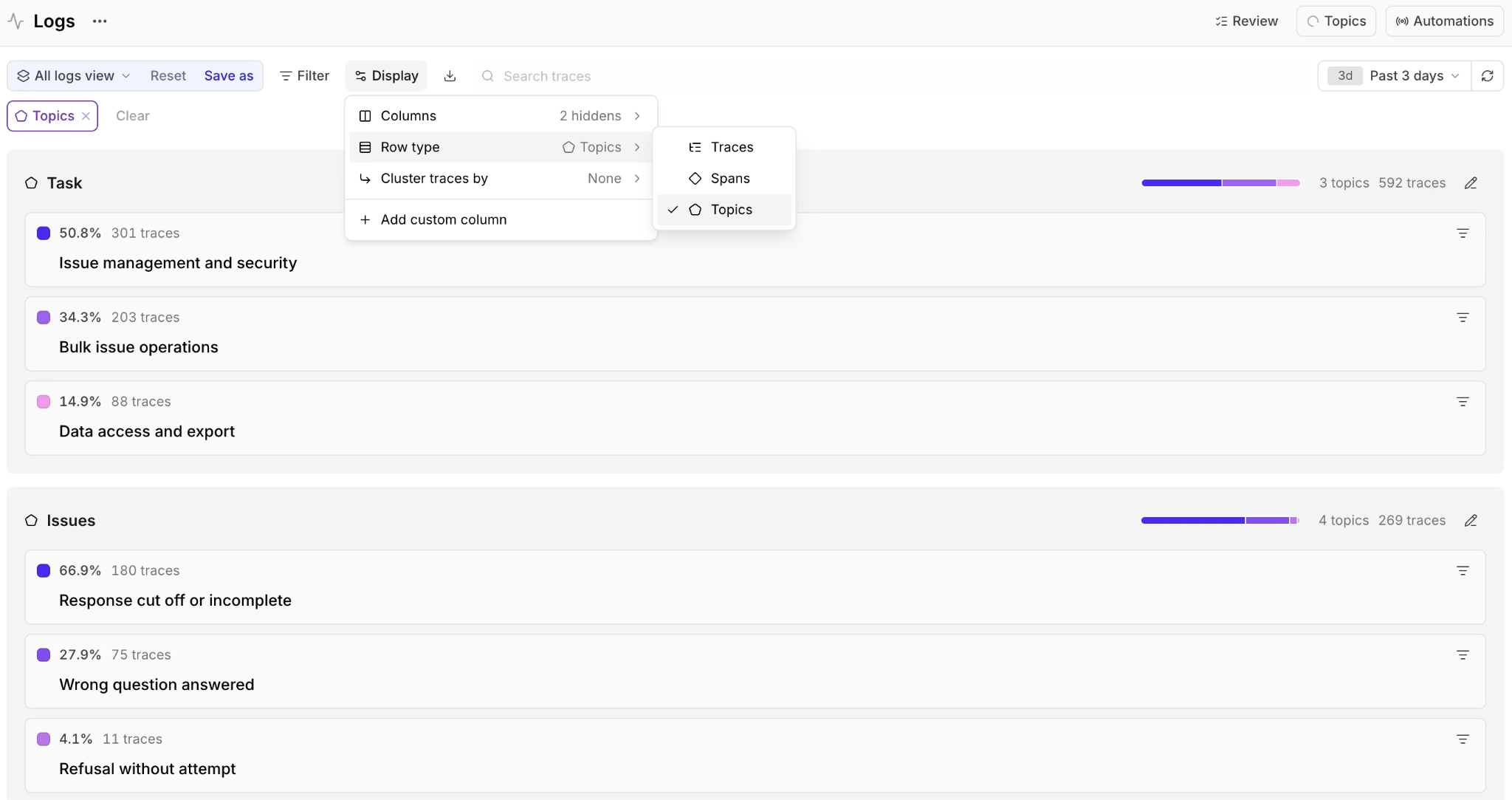
Topics analyzes production conversations through three built-in facets: Task, Sentiment, and Issues. It groups related interactions into recurring patterns, helping teams identify common requests, frustrated users, and failures that existing quality checks may have missed. Custom facets extend the analysis to product-specific questions, such as feature demand or potential churn risk. For conversations spanning multiple traces, configure a grouping key so Topics classifies the full interaction together. Classifications appear in Logs, where teams can filter conversations, query results with SQL, and examine the source traces behind each finding.
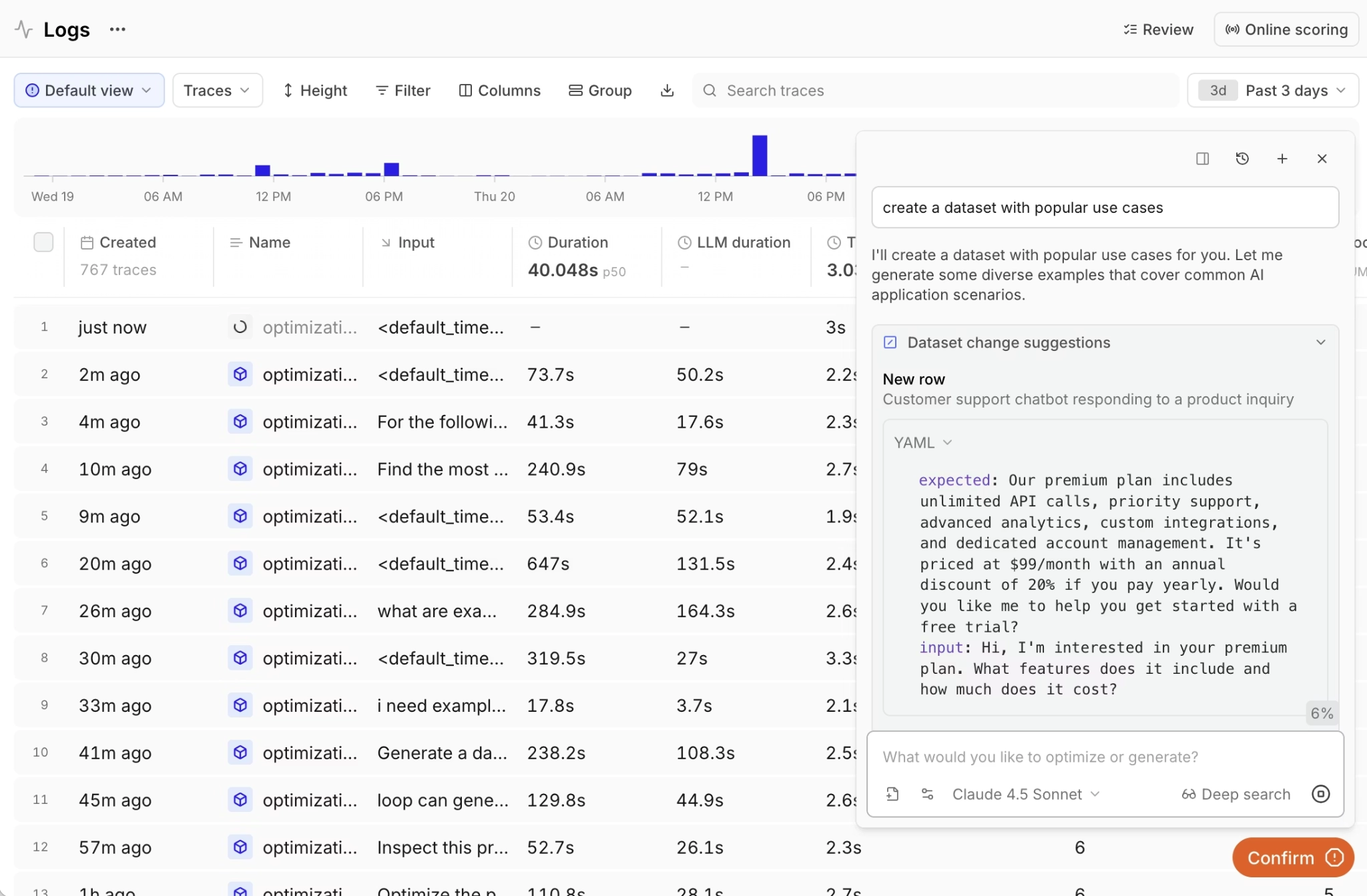
Loop opens conversation analysis to product managers, engineers, and support specialists, who question production data in plain language. A team member can explore recurring complaints, identify affected customer segments, and find similar traces to check whether an individual complaint reflects a wider problem. Loop can generate evaluation cases and scorers as well, helping teams build test coverage through natural-language requests. Human reviewers validate findings before teams promote relevant conversations into datasets, and dataset records keep links to their source traces, preserving the evidence behind individual test cases.
Once a failure pattern is validated, an online scorer evaluates incoming production traces against defined rules and sampling settings, so the team can see whether the recurring problem persists after a fix ships. Evaluation datasets built from the same failures then hold subsequent prompt and model changes to a consistent quality bar.
Start free with Braintrust to turn production conversation findings into measurable quality improvements.
FAQs about analyzing AI conversations at scale (2026)
How many AI conversations do you need before analysis is meaningful?
The required volume depends on the question, how often the behavior occurs, and the precision needed. Small datasets can reveal individual failures, but reliable segment-level comparisons generally require more observations. Braintrust Topics requires at least 100 facet summaries to generate topics. Findings should still be validated against source conversations before informing product decisions.
Can an LLM classify conversations reliably without human review?
LLM classifiers can consistently categorize well-defined intents when provided with clear rubrics and representative examples, but reliability must be measured against human-labeled data. Human review still needs to cover ambiguous conversations, emerging categories, and any classification that will steer a significant product decision, since wrong labels can change the roadmap. Use per-label precision and recall to identify where the classifier needs improvement.
What is the difference between conversation analytics and LLM observability?
LLM observability provides request-level visibility into model behavior, execution traces, errors, latency, and cost. Conversation analytics examines interactions collectively to identify user intents, recurring issues, unmet needs, and task outcomes. Braintrust connects both through production traces, allowing teams to investigate aggregate patterns and inspect the individual interactions behind them.
How often should AI conversation analysis run?
The review frequency should reflect traffic volume, release frequency, and the urgency of the findings. Braintrust Topics processes new logs continuously and regenerates topic maps daily. Teams can review trends weekly, align prioritization with planning cycles, and investigate significant quality changes immediately following a deployment.
How do you handle multi-turn conversations where the outcome is unclear?
Assign an unknown outcome when the conversation lacks sufficient evidence of task completion. Subsequent signals, such as an escalation, completed action, or repeat contact, can help establish the result when linked to the original session. Keep unresolved and unknown outcomes separate, since missing evidence does not establish failure, and review a sample of ambiguous conversations to identify missing instrumentation.