Enterprise LLM evaluation tools help teams measure model and agent quality before release and monitor performance in production. As more teams rely on evaluation results to approve changes, systems that store prompts, customer data, and scores also come under security review. Enterprise buyers therefore need to assess both evaluation capabilities and controls over data storage, access, and audit history.
Best overall: Braintrust combines evaluation-based release checks and production scoring with Enterprise BYOC or self-hosting, granular access controls, and audit logs.
Best for open-source self-hosting: Langfuse provides tracing, prompt management, and evaluation for teams that want to run Langfuse on their own infrastructure.
Best for runtime guardrails: Galileo, now Splunk Agent Observability, combines production evaluation with runtime controls for risks such as sensitive-data leakage and prompt injection.
Best for Python-based CI testing: DeepEval provides pytest-style evaluation tests, and Confident AI adds a hosted platform for datasets, tracing, and online evaluation.
Best for metrics in existing infrastructure: Ragas supplies RAG and agent evaluation metrics for teams managing execution and enterprise controls through their own systems.
Every Braintrust plan includes unlimited users, letting engineering, product, and security reviewers participate in the same evaluation process, including on the free Starter plan. Start free with Braintrust.
What is an enterprise LLM evaluation tool?
An enterprise LLM evaluation tool measures model and agent outputs against defined criteria using datasets, scorers, and production traces. A dataset supplies the test cases, and scorers assess qualities such as answer correctness or successful task completion. The results preserve enough context for reviewers to investigate failures and compare changes to prompts, models, or application code.
Evaluation can run in a test framework, a CI pipeline, or an observability platform. As results become part of release approval, teams need a consistent record of which application version was tested, which data and scoring criteria were used, and how performance changed against a baseline.
Enterprise requirements also extend to how evaluation data is managed. Prompts and traces may contain customer information, so the evaluation setup must include controls for deployment, access, retention, and auditing. A dedicated platform can provide these capabilities together, while a library-based setup requires the surrounding infrastructure to supply them.
When enterprise teams need a dedicated LLM evaluation platform
A dedicated platform becomes useful when evaluation work is difficult to maintain across teams, products, or releases. A test framework and shared dataset may be enough for one team managing a single AI feature, but coordination grows when multiple products, frequent model changes, and independent release reviewers are involved.
Repeatedly copying test cases between projects, manually assembling results for approval, or losing track of which evaluation supports a release are signs that the existing setup needs to change.
Security requirements can also make a platform necessary before evaluation volume grows. Even one application may require controlled access to customer traces, specific deployment arrangements, or auditable records that the current setup cannot provide.
What enterprise teams need from an LLM evaluation tool
Enterprise teams need an evaluation tool that meets their security requirements and fits their infrastructure and budget. Assess the capabilities included in the proposed plan and deployment, since some controls require an Enterprise contract or apply only to the vendor's hosted service.
Deployment options: SaaS, BYOC, and self-hosted
SaaS gives the vendor responsibility for operating the service. Bring-your-own-cloud (BYOC) places specified components in the customer's cloud account, often with vendor-managed operations. Self-hosting gives the customer responsibility for running those components.
Each option can split application data, authentication, and management services across different locations, so the contract should spell out what runs where and who handles upgrades, encryption keys, backups, and incident response.
SSO, SCIM, and role-based access control
Single sign-on (SSO) connects access to the company's identity provider, commonly through SAML or OIDC. SCIM automates account provisioning and deprovisioning as employees join, change roles, or leave.
Role-based access control should let reviewers work with the projects and data they need, which means permissions that distinguish between viewing traces, editing datasets, managing scorers, and administering the organization.
Audit logs and trace retention
Audit logs should identify who performed an action, when it occurred, and what changed. Verify which events are covered, including permission updates, API key creation, and changes to evaluation resources. Data-access logging may be a separate capability.
Trace retention determines how long application inputs, outputs, and execution records remain available. Check retention, deletion, and export options against review requirements. For high-risk AI systems, the EU AI Act also requires activity logging to support traceability. Administrative audit logs and application execution records provide different evidence.
Data residency and PII redaction
Data residency requirements should cover where prompts, outputs, datasets, traces, and backups are processed and stored, including any external model providers used for scoring, since each category can land in a different region.
PII redaction can mask personal information before upload or during ingestion. The timing determines whether raw data reaches the service. Check the supported data types and failure behavior. OWASP identifies sensitive information disclosure as an LLM application risk and recommends redaction and least-privilege access among its mitigations.
SOC 2, HIPAA, and GDPR compliance
A SOC 2 Type II report assesses controls over a defined period. Review its scope and findings to understand which services and controls the examination covers.
For HIPAA-covered use, a vendor acting as a business associate needs an appropriate Business Associate Agreement before handling protected health information. When a vendor processes personal data on a customer's behalf under GDPR, the arrangement requires contractual terms meeting Article 28.
Confirm which assurances cover the selected deployment. A vendor's hosted-service report does not automatically cover infrastructure operated by the customer.
Pricing that scales past 100 users
Estimate costs with engineering, product, security, and review participants included. Per-seat charges and minimum commitments can affect rollout, and free-tier seat limits can restrict a pilot.
Usage-based plans also need scrutiny. Compare charges for ingestion, storage, retention, scoring, and underlying model calls, plus the infrastructure and operating costs of self-hosting. Security controls the pilot depends on may carry separate fees or sit on a higher plan than the one quoted.
5 best LLM evaluation tools for enterprise teams in 2026
1. Braintrust
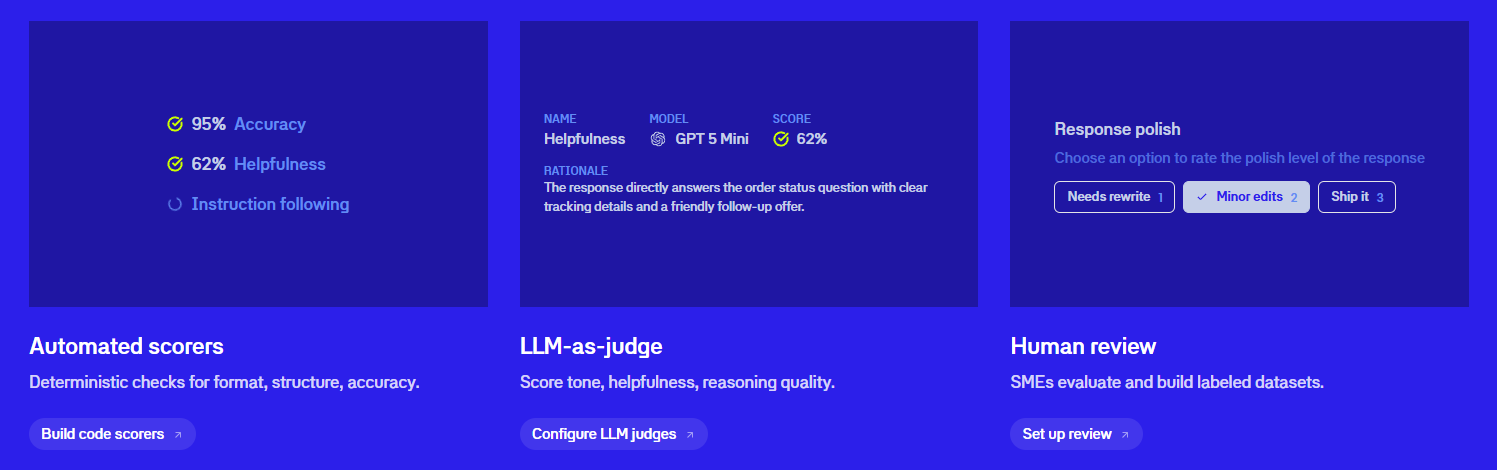
Best for: Enterprise teams that need evaluation checks before release, continuous production scoring, and control over sensitive AI data stored in their own cloud.
Braintrust combines production tracing, offline evaluation, human review, and online scoring in one platform. Results stay connected to the underlying traces and test cases, giving reviewers the evidence they need to investigate regressions before approving changes.
Evaluation, release checks, and production scoring
Offline experiments measure how prompt or agent changes perform against a dataset, using built-in scorers, LLM judges, or custom scoring logic to assess output quality. Evaluation suites can become part of release review through the Braintrust eval GitHub Action, which runs them on pull requests and posts results as PR comments.
For other CI systems, the bt eval CLI runs suites within the existing pipeline. Across CI setups, custom reporters define score-based pass/fail rules so required checks can block merges when release-critical thresholds are missed.
After deployment, online scoring evaluates production traces asynchronously in the background, outside the user request path, so it does not add latency. Confirmed failures can become regression cases, and alerts notify Slack, PagerDuty, or webhooks when configured quality conditions are met.
Interface for testing, comparison, and review
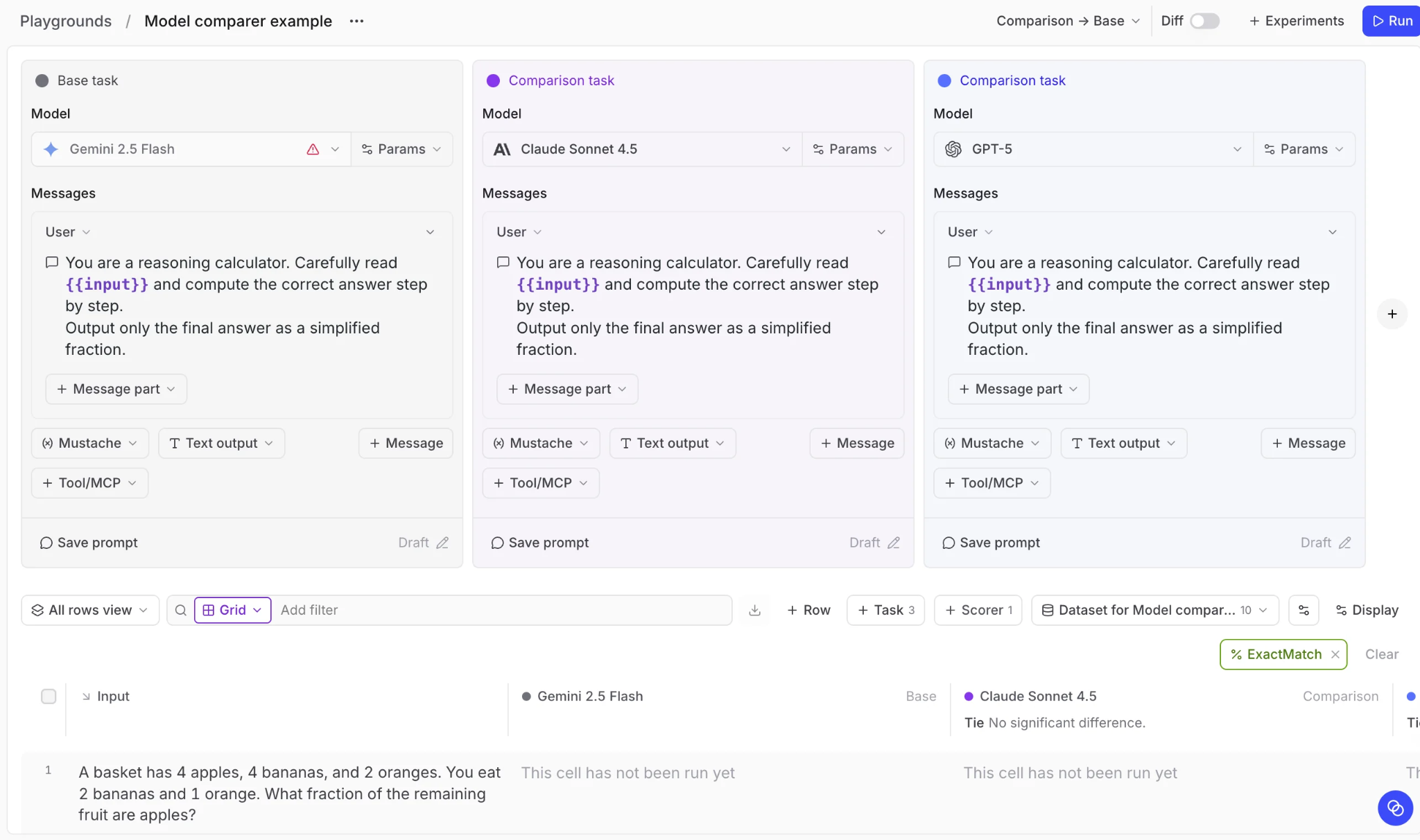
Playgrounds let developers and product reviewers test prompts, models, scorers, and datasets in the browser, comparing a base task against comparison tasks side by side. A diff toggle highlights the differences, and useful playground runs can be promoted to immutable experiment snapshots.
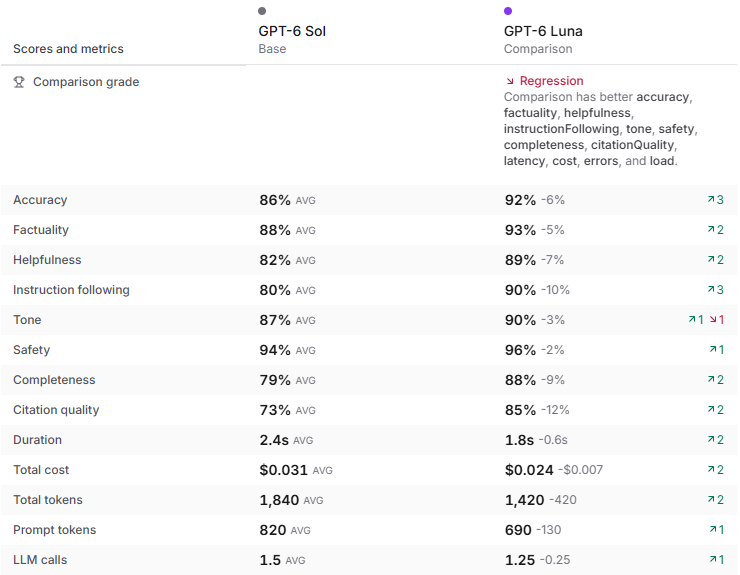
Experiment comparisons show score and metric changes against a baseline, with a comparison grade of Improvement, Regression, Tradeoff, or Tie. Reviewers can sort by regressions and inspect individual test cases to understand the failures behind aggregate results.
Human review captures structured judgments and corrections on traces and evaluation results. Reviewed failures can then be added to datasets for subsequent testing.
Loop, Braintrust's AI agent, lets product managers, reviewers, and developers work with evaluation data through plain-language requests. A collaborator can ask Loop to find recurring failures, turn examples into a regression dataset, create a scorer, and test a revised prompt, carrying the investigation through to evaluation in the same interface.
Deployment and data residency
Braintrust's deployment options separate the data plane, which stores and processes traces, datasets, prompts, and evaluation results, from the control plane for UI, authentication, and organization metadata. Braintrust operates the control plane across all deployment models.
SaaS is available on Starter, Pro, and Enterprise, with an EU data plane option. Enterprise BYOC places the data plane in the customer's cloud account, with Braintrust managing deployment, upgrades, scaling, and operational response.
Enterprise customers can also self-host the data plane on AWS, GCP, or Azure using published Terraform modules and Helm charts. SDKs and the browser communicate directly with the customer-operated data plane.
Identity and access control
Enterprise single sign-on supports SAML through Okta Workforce, Microsoft Entra ID, Google Workspace, and custom providers, plus custom OIDC providers. Enterprise SCIM provisioning, in private preview, synchronizes organization membership and mapped permission groups. API keys inherit their creator's permissions, appear once at creation, and are stored as one-way cryptographic hashes. Access controls support organization, project group, project, and individual object scopes.
Audit logs and retention
Enterprise audit logs record permission changes, member management, dataset changes, API key creation, and other administrative activity. Entries include actor and request details plus relevant before-and-after values, and reads of your data can be logged as an optional add-on. Authorized reviewers can query records through SQL in the UI, the bt sql CLI, or the API.
Enterprise retention controls support shorter deletion periods by project or organization through retention automations, and custom retention windows up to 365 days.
Enterprise cloud exports deliver logs in JSON Lines or Parquet. Braintrust-hosted deployments export to S3, and self-hosted AWS and GCP deployments support S3 and Google Cloud Storage, respectively.
PII masking and redaction
SDK masking functions and span customizers remove sensitive values before upload using customer-supplied logic. Support varies by SDK.
Ingestion redaction, in private preview, replaces detected sensitive text in selected log fields with markers such as [REDACTED_EMAIL]. Detection uses a Baseten-hosted model, can miss values, and fails open, so unredacted content may be stored when detection fails. Because selected text from the EU data plane is processed outside the EU, values that must stay inside the application need redaction before upload.
Compliance
Braintrust is SOC 2 Type II compliant, with reports available through its Trust Center under mutual NDA. Enterprise customers can execute HIPAA Business Associate Agreements. Deployment location, configured features, and external processing must also meet the organization's data protection requirements.
Pros
- Built-in scorers, LLM judges, and custom logic for task-specific quality checks.
- Pull request evaluations with custom pass/fail rules for release checks.
- Asynchronous production scoring, alerts, and human review for regression testing.
- Browser playgrounds and experiment comparisons for reviewing outputs, scores, and traces.
- Managed BYOC and customer-operated self-hosting for control over cloud data.
- Scoped Enterprise permissions, queryable audit logs, retention controls, and cloud exports.
- SOC 2 Type II assurance, HIPAA BAAs, and GDPR DPAs.
- Unlimited users on every plan for cross-functional review without per-seat charges.
Cons
- BYOC, self-hosting, enterprise SSO, custom permissions, and audit logs require Enterprise.
- Inline blocking requires a separate runtime guardrail layer.
Pricing: Starter plan is free with 1 GB of processed data per month, 10k scores per month, and unlimited users. Pro plan at $249/month. Custom Enterprise pricing available. See pricing details here.
2. Langfuse
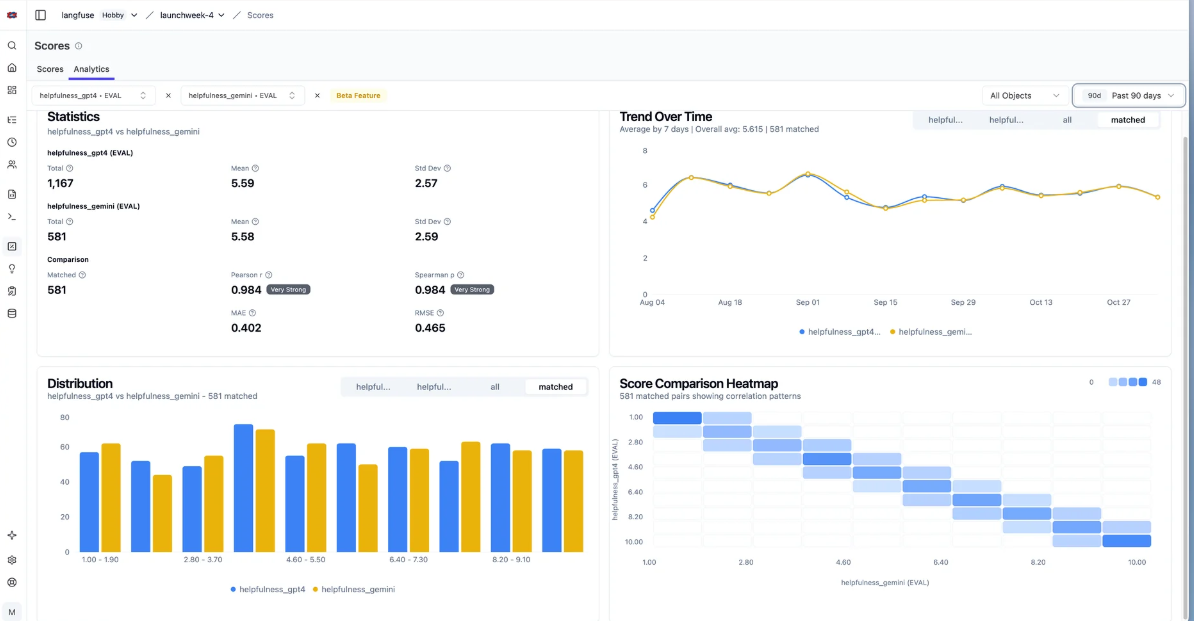
Best for: Teams with platform engineering capacity that want open-source self-hosting and control over evaluation infrastructure.
The MIT-licensed Langfuse core covers tracing, prompt management, datasets, and evaluation. Dataset-based experiments can run through the Langfuse experiment GitHub Action, which publishes PR comments and can fail CI when an experiment raises RegressionError for a configured threshold.
Self-hosting options include Docker Compose, Kubernetes with Helm, and Terraform deployments on AWS, GCP, and Azure. Langfuse Cloud provides managed hosting in the US, EU, and Japan, with a HIPAA-ready region available on Pro and Enterprise.
Pros
- MIT-licensed tracing, prompt management, and evaluation.
- Unlimited cloud users from Core upward.
- Regional cloud hosting and supported self-hosting options.
- GitHub Action with regression checks and PR comments.
- SOC 2 Type II and ISO 27001 audits.
Cons
- Cloud enterprise SSO and fine-grained RBAC require Pro plus the Teams add-on at $300/month. Audit logs and SCIM require Enterprise.
- Self-hosting involves application containers, PostgreSQL, ClickHouse, Redis or Valkey, and object storage.
Pricing: Free open-source self-hosting and a free Hobby cloud tier limited to two users. Paid cloud plans start at $29/month, with Cloud Enterprise at $2,499/month.
3. Galileo (Splunk Agent Observability)
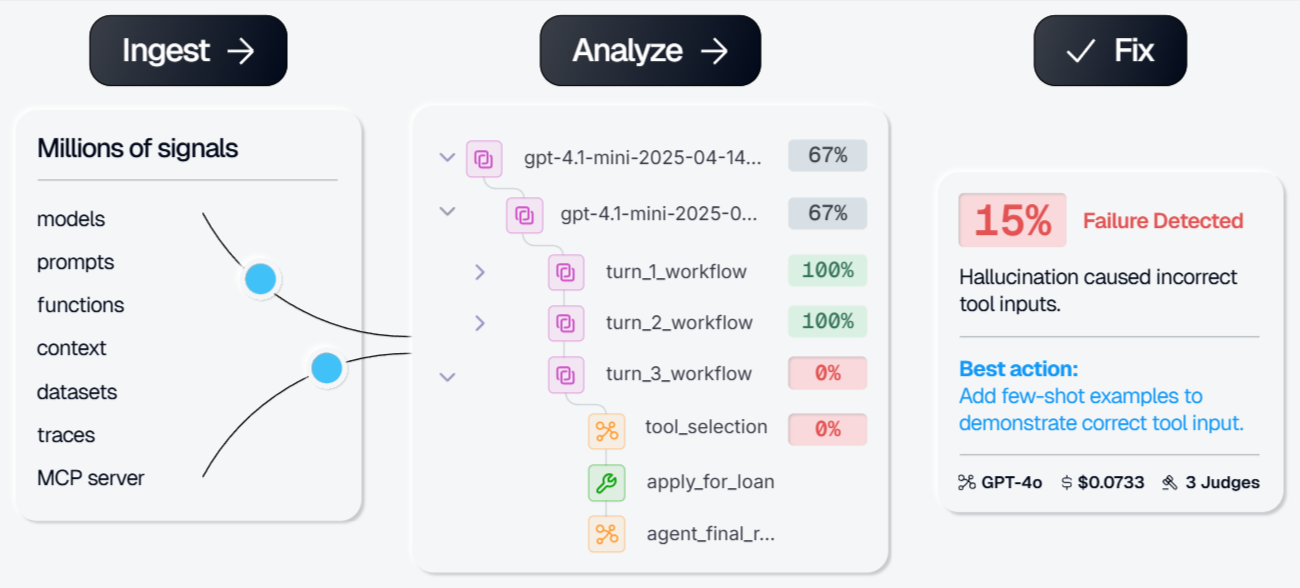
Best for: Teams combining production evaluation with runtime guardrails, particularly organizations already using Splunk.
Now part of Splunk Agent Observability following Cisco's acquisition, Galileo brings production traces, evaluation scores, token costs, and runtime controls into a shared view. Luna models, a family of purpose-built small language models for evaluation, grade AI interactions, and runtime guardrails address PII, PHI, and PCI leakage, tool misuse, and prompt injection.
Customers can use SaaS through Splunk Observability Cloud or self-hosted deployments. SSO configuration depends on the deployment, and SaaS permissions combine access-token capabilities with collaborator roles on individual resources. Galileo's security program includes SOC 2 Type II reporting and HIPAA Business Associate Agreements.
Pros
- Luna evaluation models for grading production traffic in real time.
- Runtime controls for sensitive-data leakage, tool misuse, and prompt injection.
- SaaS and self-hosted deployments.
- SOC 2 Type II reporting and HIPAA BAAs.
Cons
- Plan boundaries are in transition after the Splunk move, and Splunk does not publish a full standalone plan table. Legacy Galileo documentation restricted Luna-2 to Enterprise, while the current entry plan lists a Luna token allowance, so confirm Luna access and evaluator limits in a quote.
- Evaluation is tied to the Splunk Observability Cloud footprint, which may not suit teams standardized elsewhere.
Pricing: Splunk Observability Cloud offers a free edition for up to 15 hosts. Agent Observability starts at $100/month per 1.2 million spans annually, billed annually, including 500 million Luna tokens and 5 Luna fine-tuning runs per year. Custom enterprise pricing.
4. DeepEval and Confident AI
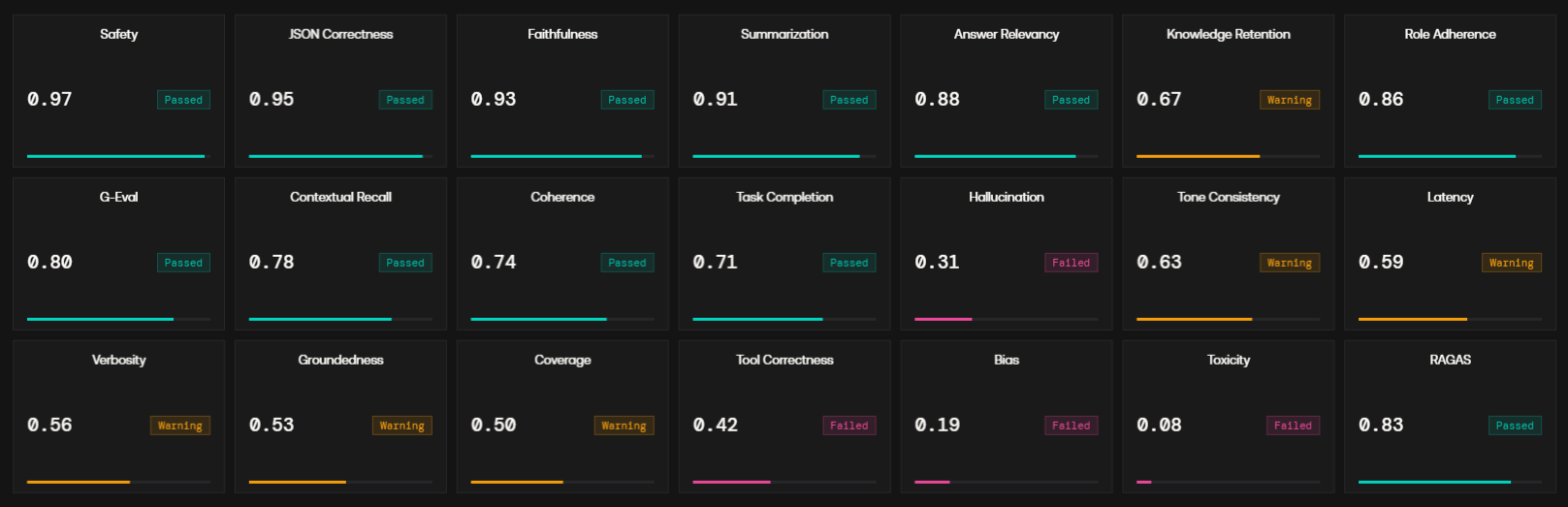
Best for: Python teams that want pytest-style evaluation tests in CI, with shared datasets and production evaluation through Confident AI.
DeepEval adds evaluation assertions to Python test suites through a pytest-compatible runner, with metrics for RAG, agents, multi-turn conversations, and safety. Running deepeval test run applies metric thresholds so failed assertions can fail a CI job.
Confident AI adds shared datasets, tracing, online evaluation, annotation workflows, and governance capabilities to DeepEval. Enterprise deployments can run on AWS, Azure, GCP, or on-premises, with custom data residency, project isolation, data masking, and a 99.9% uptime SLA.
Pros
- Apache 2.0 framework with RAG, agent, conversational, and safety metrics.
- Threshold-based CI assertions through
deepeval test run. - Unlimited Confident AI seats from Starter upward.
- Enterprise self-hosting and custom data residency.
Cons
- SSO, custom RBAC, and SOC 2 compliance start on Team at $2,000/month.
- Self-hosting and HIPAA support require Enterprise.
Pricing: DeepEval is free and open source. Confident AI has a free tier limited to two users and one project. Paid plans start at $200/month, with Team at $2,000/month and custom enterprise pricing.
5. Ragas
Best for: Teams adding RAG and agent metrics to existing pipelines, with infrastructure and enterprise controls managed elsewhere.
RAG pipelines can use Ragas, an Apache 2.0 Python library, to evaluate retrieval and generated answers separately. Context precision and recall assess retrieval quality, and faithfulness and response relevancy assess whether answers are grounded and relevant.
Agent evaluations also cover tool-call accuracy, topic adherence, and goal completion. Ragas also generates synthetic RAG test sets and provides dataset management and result tracking for repeated evaluation runs.
Pros
- Apache 2.0 library for existing evaluation infrastructure.
- Separate retrieval and generation metrics.
- Agent metrics for tool calls, topic adherence, and goal completion.
- Synthetic test sets, dataset management, and result tracking.
Cons
- Library deployments need surrounding systems for SSO, RBAC, and audit records.
- LLM-based metrics process evaluation data through the configured judge model.
Pricing: Free and open-source.
Enterprise LLM evaluation tools comparison table (2026)
| Criteria | Braintrust | Langfuse | Galileo / Splunk Agent Observability | DeepEval and Confident AI | Ragas |
|---|---|---|---|---|---|
| Best for | Release checks, production scoring, and enterprise controls | Open-source self-hosting | Production evaluation and runtime guardrails | Python CI tests with a commercial collaboration layer | RAG and agent metrics in existing pipelines |
| Starting price | Starter free. Pro $249/month. Custom Enterprise pricing | Cloud from $29/month. Cloud Enterprise $2,499/month. Self-hosted is free plus your own infrastructure costs | From $100/month per 1.2M spans annually, billed annually. Custom enterprise pricing | DeepEval free, Apache 2.0. Confident AI from $200/month. Custom Enterprise pricing | Free, Apache 2.0. Infrastructure, model usage, and enterprise controls cost extra |
| Deployment options | ✅ SaaS, managed BYOC, or customer-operated data plane on AWS, GCP, or Azure | ✅ Cloud or self-hosted through Docker, Helm, or Terraform | ✅ SaaS through Splunk Observability Cloud or self-hosted | ✅ Cloud. Self-hosting on Enterprise | ⚠️ Runs within customer-managed infrastructure |
| SSO and SCIM | ✅ Enterprise SAML/OIDC. SCIM in private preview | ✅ Cloud SSO through Pro plus the Teams add-on. SCIM on Enterprise. Self-hosted SSO available | ⚠️ Deployment-specific SSO. Confirm SCIM terms | ✅ SSO on Team and Enterprise. Confirm SCIM terms | ❌ Additional tooling required |
| RBAC granularity | ✅ Organization, project group, project, and individual object permissions | ✅ Organization roles. Cloud project-level RBAC through Pro plus Teams, or Enterprise | ✅ Resource-level collaborator roles and SaaS capability permissions | ✅ Custom RBAC on Team and Enterprise | ❌ Additional tooling required |
| Audit logs | ✅ Enterprise administrative logs, SQL queries, before-and-after changes, and optional read auditing | ✅ Cloud and self-hosted Enterprise | ⚠️ Confirm Agent Observability audit events and retention | ✅ Project and organization audit logs with exports on Team and Enterprise | ❌ Additional tooling required |
| Data residency | ✅ EU SaaS data plane, or Enterprise BYOC and self-hosting in your own cloud | ✅ US, EU, and Japan cloud regions, or customer-operated hosting | ⚠️ Confirm managed regions for Agent Observability. Self-hosting available | ✅ Custom data residency on Enterprise | ⚠️ Determined by execution environment and judge-model configuration |
| PII redaction | ✅ SDK masking before upload. Ingestion redaction in private preview | ✅ Client-side SDK masking | ⚠️ Runtime PII/PHI/PCI controls. Confirm stored-trace redaction | ✅ SDK masking before export, with configurable content capture | ⚠️ Application-managed masking |
| Compliance | ✅ SOC 2 Type II, Enterprise HIPAA BAAs, and GDPR DPAs | ✅ SOC 2 Type II and ISO 27001. HIPAA-ready cloud region on Pro and Enterprise | ✅ SOC 2 Type II reporting and HIPAA BAAs | ✅ SOC 2 on Team and Enterprise. HIPAA on Enterprise | ⚠️ Organization-managed compliance |
| CI release gates | ✅ GitHub Action, bt eval, and custom pass/fail reporters | ✅ GitHub Action failing CI on RegressionError | ⚠️ Confirm CI gating options | ✅ deepeval test run with threshold-based assertions | ⚠️ Customer-written CI checks |
| Production scoring | ✅ Asynchronous online scoring, human review, and alerts | ✅ Online evaluators, including LLM judges | ✅ Luna production evaluators and runtime guardrails | ✅ Online evaluation from Confident AI Starter upward | ⚠️ Custom production integration |
| Seat pricing | ✅ Unlimited users on every plan without per-seat charges | ✅ Unlimited cloud users from Core upward | Usage-based pricing. Confirm contractual user limits | ✅ Unlimited Confident AI seats from Starter upward | No library seat fees |
Upgrade your enterprise LLM evaluation workflow with Braintrust
How LLM evaluation results connect to release gates and AI governance
Evaluation results support governance by letting reviewers confirm what was tested, which release requirements were met, and whether the deployed configuration matches the approved version.
Score thresholds as release gates
Define the scores and failure conditions that should block a release before testing the candidate. Review case-level regressions alongside aggregate scores so improvements on common inputs cannot hide a failure on a critical case.
A prompt CI/CD pipeline can use bt eval --first N for early feedback on a subset of cases, followed by the full suite before final release approval. Required checks need explicit pass/fail rules tied to the release criteria.
Approval history and audit evidence
Attach the evaluation results to the pull request or release ticket, together with the tested configuration, dataset version, scorer version, and code commit. Record the reviewer's decision and any accepted exceptions in the approval process.
Administrative audit logs complement the release record by documenting changes to resources and access. Set retention and export policies that keep supporting evidence retrievable throughout the required review period.
Production failures as regression tests
Review failures identified through production scoring, user feedback, or incident investigation before adding them to release requirements. Preserve the original input, expected behavior, failure category, and source trace when turning production failures into regression tests.
Subsequent releases should run the updated suite, making the incident's corrective action testable.
Where runtime guardrails fit
Release gates assess a candidate before deployment, and runtime guardrails apply policy checks to individual live requests. An application may need both when unacceptable behavior requires immediate blocking or redaction.
Keep evaluation and runtime enforcement aligned on policy definitions and failure categories. Guardrail interventions can then inform incident review and future regression tests.
Also read: Best AI governance platforms for LLM applications and Best AI evals products for self-hosted and on-prem enterprise deployments
How to choose an enterprise LLM evaluation tool
Use a representative application change to test shortlisted tools through the organization's actual release process. Keep the pilot scope consistent so differences in implementation effort, reviewer participation, and operating costs are easier to assess.
Confirm deployment eligibility first: Ask security and procurement to approve the proposed deployment model and identify required contract terms before engineering begins integration. Confirm that the quoted plan includes the controls needed for the pilot and eventual rollout.
Evaluate the same change across candidates: Build an evaluation dataset containing routine requests, known failures, and release-critical cases. Keep application versions, scoring criteria, and model settings consistent. Check whether each tool preserves enough context to investigate a failed case and reproduce the evaluation.
Include the people who approve releases: Have engineers configure the tests, product or domain reviewers assess ambiguous outputs, and security reviewers inspect access and audit evidence. Record where participants need engineering assistance or additional permissions to complete their work.
Price the operating model tested in the pilot: Request quotes for the required enterprise configuration using observed trace volume, scoring frequency, retention, and reviewer participation. Include judge-model charges and the staff time needed to maintain integrations or operate self-hosted infrastructure. Select the candidate that meets the release and security requirements within an operating model the organization can sustain.
Why Braintrust is the best LLM evaluation tool for enterprise teams
Braintrust gives enterprise teams a continuous path from identifying an AI failure to validating the fix. Engineers can investigate the underlying behavior, product reviewers can clarify the expected result, and confirmed failures can become tests for subsequent releases. Evaluation work accumulates into a reusable record of what the application needs to do as prompts, models, and agents change.
For applications handling sensitive data, organizations can choose managed BYOC or customer-operated hosting for the data plane, control access to evaluation resources, and retain evidence for internal review. Because user counts are unlimited on every plan, adding security and product reviewers to the process costs nothing extra.
Box uses Braintrust evaluation datasets to define agent launch requirements, including an 80%+ score threshold before internal release. Notion coordinates evaluation across 70 engineers and reports deploying new frontier models in under 24 hours.
Book a Braintrust demo to plan your enterprise evaluation workflow
FAQs about enterprise LLM evaluation tools (2026)
What is an enterprise LLM evaluation tool?
An enterprise LLM evaluation tool tests whether an AI application meets defined quality requirements and provides controls for managing evaluation data across an organization. Tests can assess answer correctness, retrieved context, tool selection, and whether an agent completes the requested task.
What should I look for in an LLM evaluation platform for a production LLM application?
Check whether reviewers can investigate a failed customer interaction, reproduce the problem, and verify a proposed fix. Test a realistic application failure during the pilot, then assess the captured evidence, reviewer access, scoring costs, and retention requirements.
Which LLM evaluation tools offer granular RBAC and PII redaction?
Braintrust combines object-scoped permissions with SDK masking before upload. Langfuse offers project-level roles and client-side masking, and Confident AI provides custom RBAC and SDK redaction. Compare permission scope and masking coverage separately, including whether sensitive values reach storage or external scoring services.
Which LLM evaluation platforms support audit trails and on-prem deployment for regulated industries?
Confident AI explicitly offers on-premises deployment and audit logs. Braintrust and Langfuse also provide self-hosting and audit logging, subject to plan requirements. With Braintrust self-hosting, the data plane runs in customer infrastructure, and the control plane remains Braintrust-hosted.
Is Braintrust better than Langfuse for enterprise teams?
Braintrust is the stronger choice for enterprises seeking managed BYOC, where Braintrust operates the evaluation data plane in the customer's cloud. Langfuse appeals to organizations prioritizing an MIT-licensed core and direct responsibility for operating their evaluation infrastructure.
How does LLM evaluation relate to AI governance and runtime guardrails?
AI governance uses evaluation evidence to define acceptable behavior and authorize releases. Runtime guardrails enforce policies during live interactions, including blocking or redacting individual requests. Braintrust produces the evaluation and review evidence, while a separate guardrail layer enforces policies at runtime.
What is the difference between open-source evaluation libraries and enterprise evaluation platforms?
Libraries provide evaluation components that developers integrate into their own code. Enterprise platforms coordinate evaluation across people and projects through shared records, permissions, and review processes. Both can work together when a team wants to use custom metrics within a centrally managed evaluation program.
Which LLM evaluation platforms include unlimited users?
Braintrust includes unlimited users on every plan, including the free Starter plan. Langfuse Cloud includes unlimited users from Core upward, and Confident AI from Starter upward. Costs still depend on contracted usage, deployment, and support requirements.